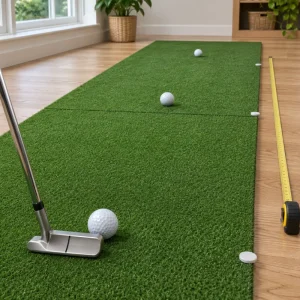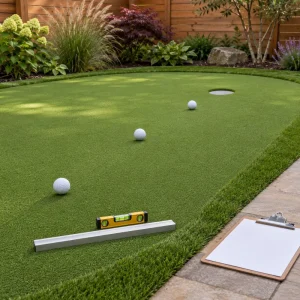
Putting green speed is a standardized golf-ball roll distance in feet: the mean measured with the Stimpmeter’s standard 1X notch, or twice the mean measured with its genuine 2X notch. A higher Stimp reading means a faster green, but the fastest green can be the least useful choice for daily practice.
If you’re comparing artificial turf, a number such as “10” looks reassuringly precise. Yet that number means little without the test method, surface preparation, and supporting base. A sloping backyard green and a flat indoor lane can feel different even when a valid level-area test gives the same reading.
You want practice that makes sense for your game. That means choosing putting green speed alongside your available space, usual course conditions, and the putts you want to rehearse. It also means checking whether the supplied system can reproduce the advertised ball roll.
This guide explains how to read a stimp rating, measure consistently, and evaluate an installed synthetic surface. The measurement steps follow the United States Golf Association’s published instructions. You’ll also find practical questions for suppliers, so you can compare evidence before committing to a turf specification.
Key takeaways
- A Stimp reading of 10 describes a standardized roll distance of 10 feet, not a ball velocity of 10 mph.
- Standard 1X testing uses three balls in each direction, with an 8-inch stopping spread limit.
- A genuine 2X notch uses tighter 4-inch and 9-inch limits; double its measured distance to obtain the reading.
- X-Nature’s published 16mm pile height does not establish a numeric Stimp result; assess the complete installed system.
What putting green speed and Stimp readings mean
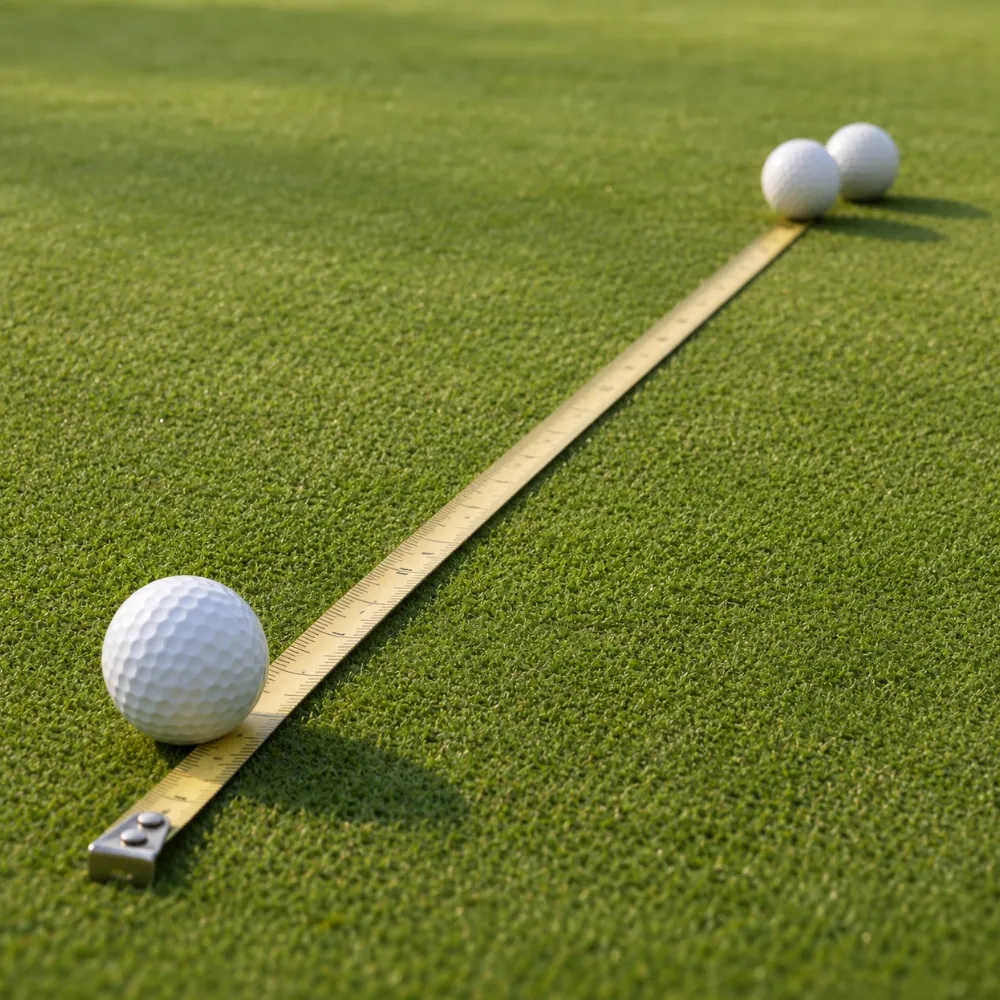
Putting green speed describes how readily a surface allows a ball to travel after a controlled release. The Stimpmeter provides that release so a golfer’s changing stroke doesn’t determine the test result. You measure the travel distance after the ball leaves the device, then average valid runs in opposite directions.
PGA Play’s golf terminology guide identifies green speed as a numerical measure commonly checked with a stimp meter. The practical distinction is distance: a stimp rating of 8 represents an 8-foot roll, while 12 represents a 12-foot roll under the prescribed method.
Those examples explain the scale. They aren’t universal quality grades, and a stimp rating doesn’t certify that a green resembles a particular tournament venue.
Before comparing quoted speeds, compare putting-green turf systems by application, supporting layers, and the evidence available for each construction.
Check putting green speed alongside surface quality
A surface can produce a long ball roll yet have raised seams, bumps, or uneven patches. Those defects can affect direction or consistency without being explained by one average number. Watch the travel path as well as the final stopping point.
Putting green speed also tells you little about a chip shot landing on the surface. Reception depends on the complete assembly and the incoming shot. If chipping matters, ask for a separate demonstration with agreed shot conditions rather than assuming a stimp rating proves it.
Use the reading to define the pace you want to practise on. Evaluate smoothness, directional consistency, and usable cup positions separately before accepting the finished green.
How to measure putting green speed reliably
To test putting green speed, use a sound Stimpmeter, three golf balls without damage, markers, a tape measure, and a record sheet. Follow the USGA Stimpmeter instruction booklet, particularly its instructions for level test areas and repeatability.
For your initial baseline, test a clean, smooth, dry surface on a calm day. Record wet or windy tests separately, and compare readings taken under similar conditions. Record the Stimpmeter notch and ball roll distances with each stimp rating.
Run the standard 1X test
- Find a level lane. The booklet starts with an area several feet wide and 10–12 feet long. Allow enough room for the ball to stop freely; a wall or return ramp invalidates the run.
- Mark the start. Rest the tapered end beside the marker and aim along the lane. On synthetic turf, use a removable marker that won’t puncture the backing.
- Release three balls. Place each ball in the Stimpmeter’s standard 1X notch, raise the device slowly until release, and hold it steady. Keep its lower end at the same position.
- Check the stopping spread. The three balls should finish no more than 8 inches apart. Repeat the series if they don’t, then mark their average stopping point and measure from the start.
- Reverse the direction. Start the second three-ball series at that average stopping point and aim back along the same line. Check the spread again and measure the second distance.
- Average the two distances. If their difference exceeds 18 inches, the USGA questions the accuracy. Select another suitable area or follow its guidance for the alternate notch.
For example, mean rolls of 9 feet 6 inches one way and 10 feet the other give a stimp rating of 9 feet 9 inches. The two means differ by 6 inches, within the allowed limit. Each set of three balls must also pass the spread check.
Don’t average away an invalid series. A long downhill run and a short uphill run can produce a plausible number while failing the method.
Use the 2X notch correctly in smaller spaces
The alternate 2X notch on a suitable USGA Stimpmeter can test level areas as short as 6 feet. It uses the same basic procedure, but the stopping spread reduces to 4 inches and the directional difference limit to 9 inches. Double the measured average distance to calculate putting green speed.
If those limits cannot be met, the booklet says a valid speed is unlikely. Don’t assign a stimp rating by shortening a homemade ramp or testing against a room boundary. Instead, describe any informal ball roll comparison as informal.
Choose a speed for your practice and contours
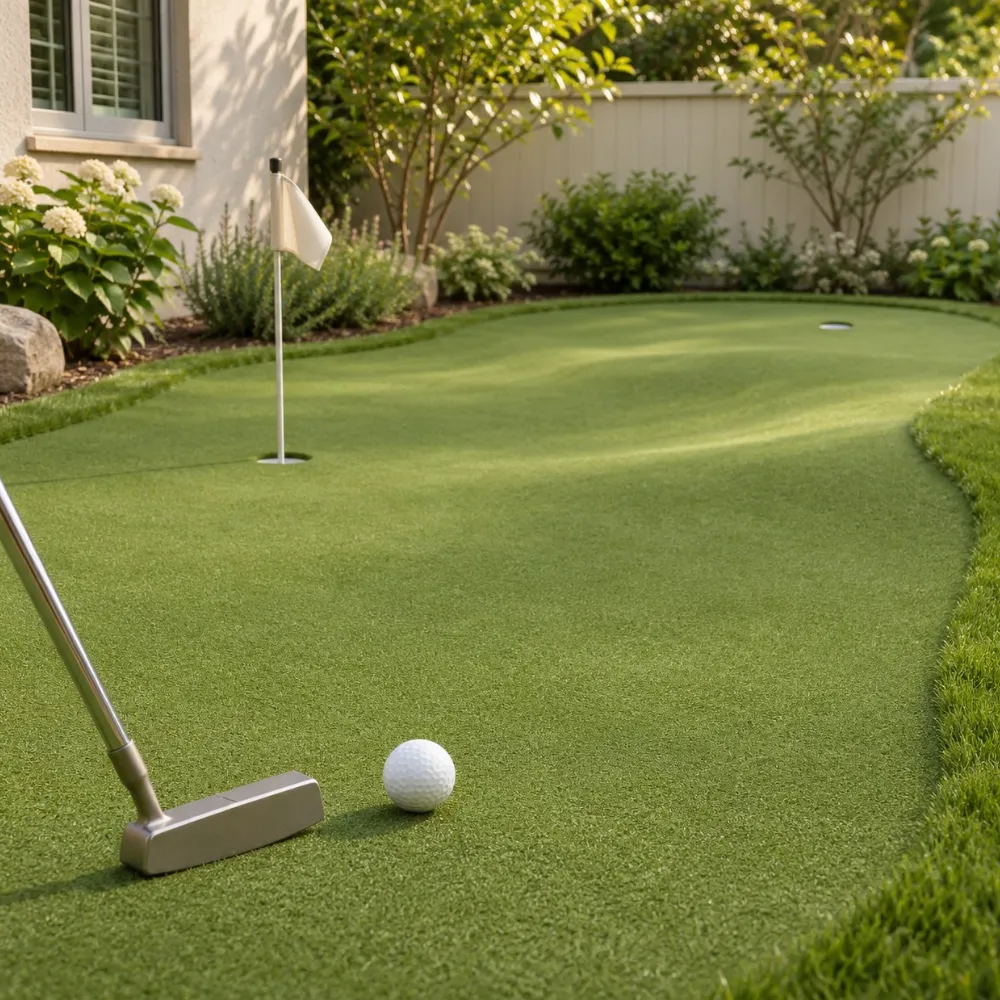
Choose putting green speed around the course conditions you want to rehearse, then check whether your design supports it. A familiar pace gives you a useful reference for distance control. A deliberately faster surface may suit a particular drill, but it shouldn’t become a default quality requirement.
For a starting discussion, supplier US Turf Direct recommends a Stimp range of 8–10 for home greens. That is supplier guidance, not a universal USGA target or a guaranteed X-Nature specification. Compare any proposed stimp rating with your own goals and a representative demonstration.
Match the pace to the available putts
Short, steeply contoured greens leave less room for a ball to slow near a hole. Before asking for faster putting green speed, check downhill putts from several positions. Can a sensibly played ball finish near the cup, or does it repeatedly leave the usable area?
For a shared practice facility, consider beginners, experienced players, and the available cup locations. The USGA booklet specifically warns that faster isn’t necessarily better. A stimp rating should support playable design rather than dictate it.
Hypothetical example: Alex’s home practice plan. Alex compares a flat test green with a planned 12-foot backyard lane. Their usual practice green is said to run at roughly 9, while one supplier promotes a reading of 12. Alex asks to try turf close to their usual pace before adding slopes.
They choose that pace as a first target and ask for a sample laid on the planned base for testing. The result is a clearer buying brief, not a promise of lower scores.
Putting green speed is easier to specify when you can explain the intended practice. Note whether you want short start-line drills, longer distance control, or a mixed-use leisure area. These needs may call for different layouts even when the ball roll feels similar.
What changes artificial putting green speed
Artificial putting green speed comes from the whole construction: fibers, backing, supporting layers, installation, surface condition, and any specified infill. Infill means material placed among the fibers; whether it is required, and how much, depends on the exact turf system.
Compare complete constructions
Pile height alone cannot predict ball roll. X-Nature’s 7016 putting-green turf has a published pile height of 16mm. That dimension is a product specification, not evidence of a particular putting green speed.
The same care applies to fiber material. Our PE versus PP golf-turf comparison explains why the way turf is made and used matters when choosing fibers. Ask for a roll test on the planned turf and base; a fiber name alone doesn’t give you a stimp rating.
Diagnose the cause before changing the surface
Debris, wet patches, raised joins, uneven support, and changes in fiber orientation are worth checking when ball roll varies. Inspect the place where the ball changes direction or pace. A local seam problem calls for a different response from a broad difference between two prepared samples.
Don’t assume that adding sand always increases putting green speed, or that removing it always slows the surface. Follow the exact manufacturer’s installation and maintenance instructions. Ask which treatments are permitted before using heavy rollers, cutting fibers, or applying heat.
If an approved adjustment is available, change one variable at a time. Record the treatment, let the assembly reach its specified test condition, and repeat the Stimpmeter procedure. This makes a change in putting green speed traceable rather than a matter of memory.
For future checks, keep your ball type, Stimpmeter, lane, and prep method the same. Don’t compare a stimp rating from a clean, dry green with a wet reading that has no test notes. Record the state of the turf whenever you record ball roll.
Specify and check the installed surface
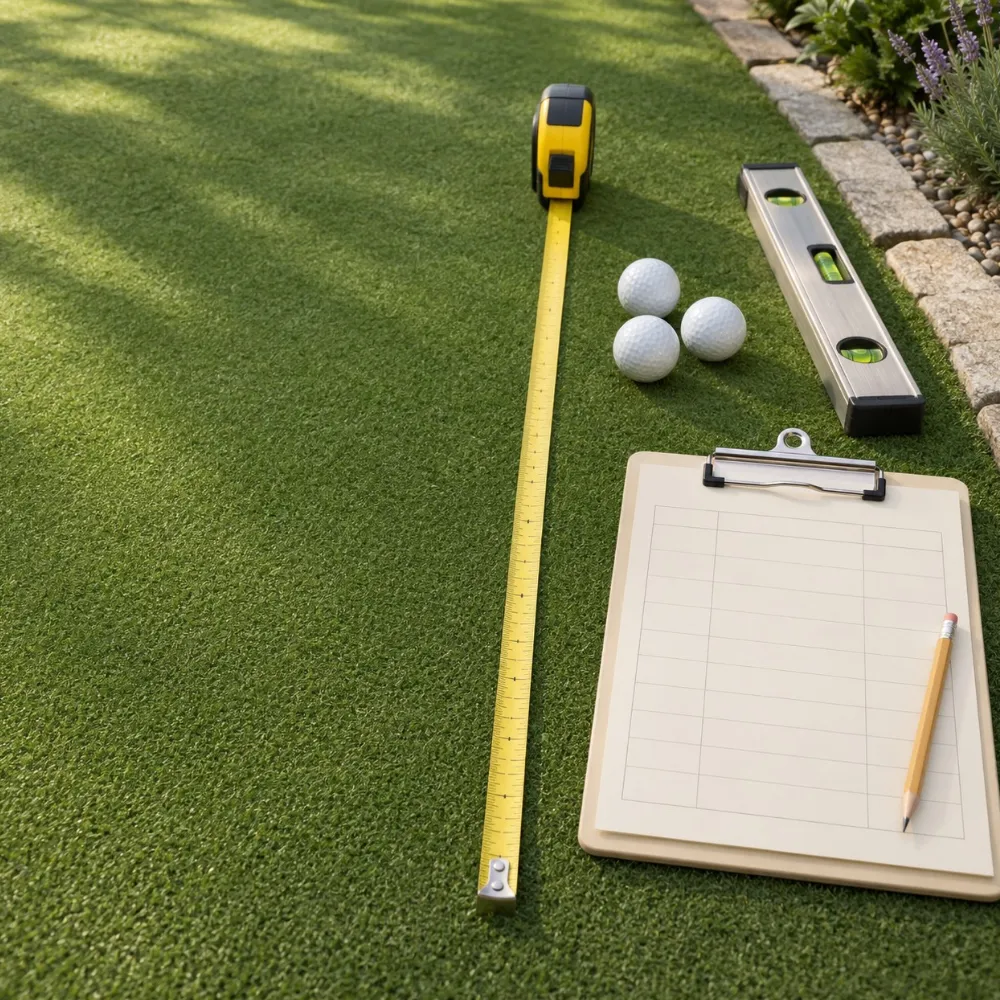
Treat putting green speed as an acceptance question before ordering. Request the model, supporting layers, infill requirement, preparation method, and measurement conditions behind any quoted number. If the supplier cannot provide them, treat the number as a claim to investigate.
Agree what the test will include
A small hand sample can show color, texture, and backing, but it can’t support a valid long ball roll test. Ask for a large enough test area with the planned turf and base. Check that the finished green will have a level lane that fits the chosen Stimpmeter method.
Use a record such as this when you try the turf and when the finished green is handed over:
| Record field | What to write down |
|---|---|
| Surface | Model, batch identification, supporting layers, and specified infill |
| Preparation | Cleaning, approved grooming, elapsed time, and surface moisture |
| Location | Lane position, orientation, and level-area suitability |
| Equipment | Stimpmeter identity, 1X or 2X notch, and ball type |
| Measurements | Three rolls each way, stopping spreads, directional means, and calculated stimp rating |
| Acceptance | Target stimp rating, permitted variation, correction process, and retest date |
Agree in writing how much speed may vary across your green. The USGA limits check whether a test is valid; they don’t set the terms of your purchase. Record each lane on its own before you judge putting green speed across the whole site.
Hypothetical example: Jordan checks a handover reading. Jordan runs a small practice area. The first Stimpmeter test gives a mean roll of 11 feet one way and 8 feet the other, a gap of 36 inches. The simple mean is 9.5, but Jordan rejects it as a valid 1X result because the gap exceeds 18 inches.
They choose another level lane and repeat both sets of rolls. The result is a sound test record before handover; the failed first test doesn’t prove the turf is at fault.
Keep a baseline for future checks
Write the putting green speed in feet and inches, and label any decimal value you use. Keep each ball roll as well as the mean. A second person can then check the sums without having to repeat the whole test just to find a unit error.
Take a photo of the test lane and save the raw readings with the final putting green speed. If a later test differs, compare the prep work and turf conditions before you agree to a change. Check for damage or moved seams too.
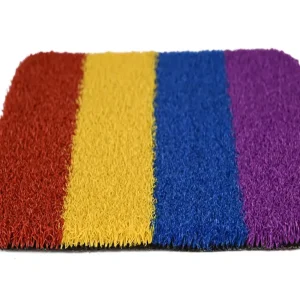
Considering a colored practice layout? Review the published GOLF7016G model details, then ask if samples are available and how to test the planned turf and base. Its 16mm pile and color choices don’t prove a set speed or the same ball roll across each part of a joined design.
Questions about green speed
What does a Stimp reading of 10 mean?
With the standard 1X notch, a valid mean roll of 10 feet gives a stimp rating of 10. With the genuine 2X notch, a valid mean roll of 5 feet is doubled to report 10. It doesn’t mean 10 mph or the distance from your own stroke. Both directional series must pass the test limits.
What is a good speed for a backyard green?
A good putting green speed suits your practice goals, skill, and slopes. The supplier range of 8–10 above is a starting point, not a rule for every home green. Try the planned turf and base, and check where balls can stop before you choose a faster pace.
Can I measure a short indoor putting lane?
Only if the lane is large and level enough to meet the chosen test method. A genuine 2X notch can help in a short level area, but its limits are tighter. If the balls can’t roll freely and pass the test both ways, call it a ball roll comparison rather than a formal reading.
Can I make artificial turf faster after installation?
It may be possible if the turf maker allows a change to that model. Ask the supplier to find the cause, give you an approved method, and plan a retest. Don’t cut fibers or alter infill just to chase a higher number; other traits of the green may change too.
Does a faster surface receive chip shots better?
No. Putting green speed measures roll, while a chip test shows how the ball lands, bounces, and then runs. If both uses matter, try both on the planned turf and base with the shots you want to play. One speed reading can’t replace a chip test.
Choose a repeatable pace
The right putting green speed is a pace you can explain, measure, and use. Start with the pace you know and the space you have. Then check how the planned slopes affect where a ball stops, rather than choosing the largest number in a sales claim.
A sound comparison needs a level lane, a steady Stimpmeter release, valid stopping spreads, and rolls in both directions. Keep the raw figures. They help you tell a sound test from a neat mean that hides a slope or a failed set of rolls.
For synthetic turf, compare the turf and base together, and ask which changes the maker permits. Keep the first ball roll record as a guide for future care. Pile height, color, and the feel of a hand sample all help you choose, but they don’t replace a roll test.
To discuss putting green speed for your project, send X-Nature your area, location, practice goals, and target pace. Ask which model suits the plan, if samples are available, what base is needed, and how the speed was tested before you agree the final brief.