Introduction
A Putting Green Turf is judged by behaviour, not appearance. The ball has to roll true, hold its line, and behave the same way on the tenth putt as on the first. Underfoot, the surface has to feel consistent enough that a player can trust the ground when setting up. Buyers often begin with pile height and colour, but the polymer used to make the filaments sets much of that behaviour before a single roll is laid.
This article compares polyethylene (PE) and polypropylene (PP) as turf polymers, explains how each one shapes the way a surface plays, and sets out how to match the choice to climate, usage and budget. The final section applies the comparison to one short-pile specification in detail.
What PE and PP Actually Are
Both materials are thermoplastics extruded into thin turf filaments. The molecular structure differs, and that difference shows up in the finished surface. PE filaments are softer and more flexible, so they bend rather than resist. PP filaments are stiffer and hold their shape more firmly, which makes the surface feel crisper and more uniform. Neither is universally better; each suits a different job.
How the Two Polymers Behave on a Green
On a golf surface, four behaviours matter most: foot feel, recovery after compression, the way the ball rolls, and how the material ages. Looking at PE and PP side by side makes the trade-offs clear.
Softness and Foot Feel
PE filaments give way underfoot, which produces a softer, more grass-like feel. PP filaments are firmer, and at short pile heights that firmness can read as a slightly abrasive surface on bare skin. For a green where players stand in one place for extended practice, feel is not a minor detail.
Resilience and Recovery
A putting surface has to return to its original shape after repeated compression. PE generally recovers well, which helps the surface stay level across a practice session. PP is more dimensionally stable in the sheet, but individual filaments can flatten over time in high-traffic zones, and a flattened zone changes how the ball behaves.
Ball Roll and Surface Consistency
Consistency matters more than absolute speed on a golf putting green turf. Crimped, non-directional filaments reduce the grain effect that makes a ball break differently depending on the direction of play. The polymer still influences the result, because a softer surface absorbs a little more of the ball impact while a firmer one returns it more sharply. On a green built for repeatable practice, that difference is felt by the player long before it is measured.
UV Resistance, Heat and Wear
Outdoor surfaces sit in sun for years. PE is generally more resistant to ultraviolet degradation, and it keeps its colour and flexibility longer when properly stabilized. PP can become brittle under prolonged exposure unless it carries sufficient UV stabilizers. Heat build-up also differs between the two, and darker colours absorb more of it, which is one reason colour choice and polymer choice are usually considered together.
Cost and Service Life
PP typically costs less per square metre, which is why it dominates decorative and light-use applications. PE costs more but usually lasts longer under sport use. Nylon (PA) sits above both in durability and price, and is normally reserved for the most demanding surfaces. The useful comparison is not price per square metre but cost across the years the surface will actually be used.
Where PP Artificial Grass Makes Sense
PP artificial grass is often the practical choice where a firm surface and a lower price matter more than softness. Landscaping edges, decorative areas, temporary displays and low-traffic zones all suit PP well, because the surface does not need to absorb repeated impact or deliver a consistent ball roll. It is a material choice driven by the job, not a compromise.
Why PE Usually Suits a Putting Green Better
Golf surfaces ask for the opposite set of priorities: softness underfoot, reliable recovery, and a roll that repeats. PE meets those demands more naturally, which is why most Synthetic Grass products intended for golf are made of PE or a PE blend. The softer filament absorbs impact, the crimped structure keeps the surface non-directional, and the result is a green that plays the same way in both directions.
A Side-by-Side Comparison
The table below summarises the practical differences. It describes general material behaviour, not the performance of any specific product.
| Aspect | PE (Polyethylene) | PP (Polypropylene) |
| Softness | Softer, more grass-like underfoot | Firmer, crisper feel |
| Recovery | Springs back well after compression | Can flatten in heavy-traffic zones |
| UV and ageing | Good resistance with stabilization | Needs sufficient stabilization to avoid embrittlement |
| Ball roll | Slightly absorbed, consistent direction | Firmer, faster return |
| Relative cost | Higher | Lower |
| Typical use | Golf, sport surfaces, frequent use | Landscaping, decorative, light use |
How to Choose: A Short Decision Guide
For a club, academy or resort specifying golf artificial grass, five questions usually settle the material decision. How intense is daily use, and will the surface be played on every day or only at weekends? How strong is the sun at the site, and does the installation face full exposure? Does the green need to deliver competition-consistent roll, or is it a leisure feature? What service life does the project plan assume, and what is the cost across that life rather than at purchase? Finally, what base can the site support, since a soft surface on a poor base will not perform as intended.
Answer those five and the polymer choice usually follows. Where softness, recovery and repeatable roll are the priority, PE is the natural fit. Where the surface is decorative, sheltered, or expected to be replaced rather than maintained for years, PP offers better value.
The 7016 16mm Putting Green Turf: A PE Specification
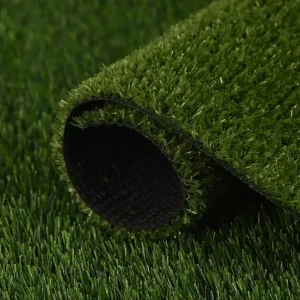
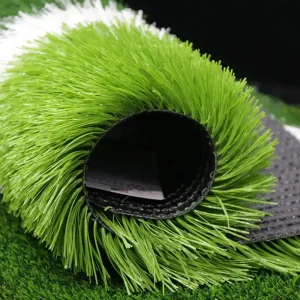
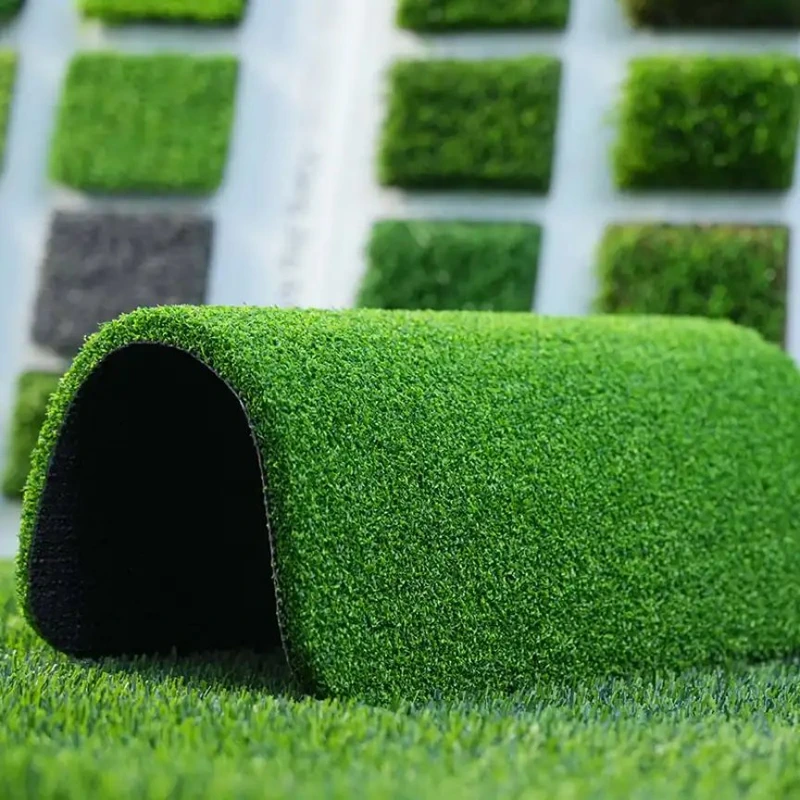
The 7016 is a 16mm putting surface made from PE/6000D filaments in a two-colour composition. It is designed for golf courses and gateball courts, where a short, dense pile supports a predictable roll. The filaments are crimped, so the surface is non-directional; that is what keeps footing steady and makes ball speed and trajectory controllable rather than dependent on which way the green was laid.
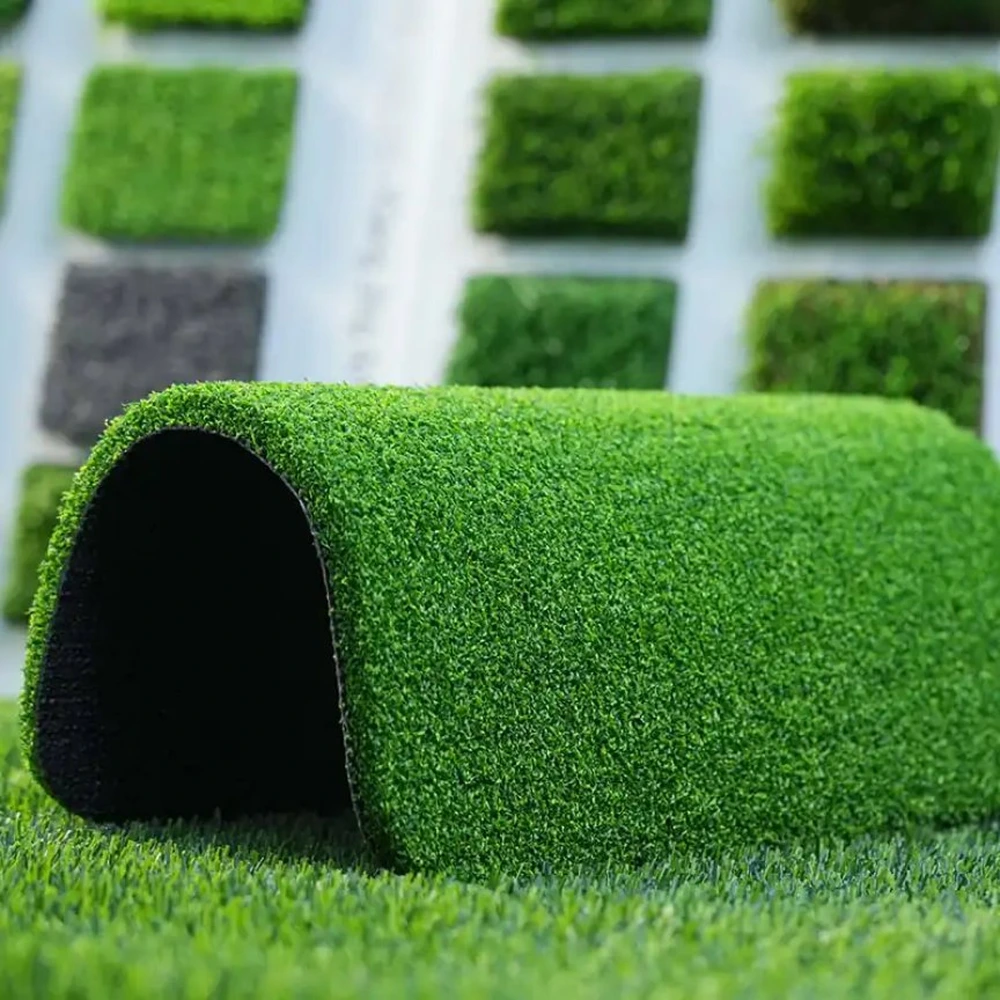
The material carries a sufficient amount of UV stabilizers, and the turf is built for wear resistance. It is UV-resistant and heat-insulating, flame-retardant, and designed for automatic water permeation. It is non-toxic and antibacterial, and the construction is rated as safe and eco-friendly. A thick backing adhesive supports the filament rows, and the overall build is intended for long service.
Practical characteristics follow from that construction. Maintenance is simple and low-cost, the surface stays usable in all weather and is unaffected by season, sun exposure or rain, and it is suited to frequent use with consistent performance. Because turf can be manufactured to the same standard across an order, competitions held on it are fairer. Field lines are woven into the turf rather than painted on, so their colour stays consistent, and a matte colour masterbatch keeps the surface glare-free. Under normal conditions the turf is expected to last six to eight years. The structure is also highly resilient, which helps reduce the risk of sports injuries.
Material selection is not fixed to one polymer across a range: turf materials can be specified as polypropylene (PP), polyethylene (PE) or nylon (PA) depending on regional climate and usage frequency. The 7016 uses PE, which is the choice described above for golf surfaces.
Technical Specifications
| Item | Detail |
| Model | 7016 |
| Material | PE/6000D |
| Pile Height | 16mm |
| Gauge | 5/32 inch |
| Density | 84,000 stitches/㎡ |
| Back Coating | XPU |
| Colour | Two-colour |
| Weight | 2.56 kg/㎡ |
| Roll Size | 4m (width) × 25m (length) |
| Backing | Three-layer fibreglass high-stabilization anti-aging black-green base fabric |
| Package | By roll in PP bag |
Where It Is Used
The 7016 suits residential backyard putting greens, golf clubs and training academy practice areas, hotel and resort leisure zones, corporate office rooftops and terraces, indoor golf simulator supporting venues, luxury community amenity areas, and mini golf courses.
Installation Requirements
The surface performs as intended only when the base is right. Paving follows four steps.
1. Site levelling and hardening. A hard foundation is required, such as cement, asphalt, concrete or another rigid base. Turf can be laid directly on hardened ground; where the ground is not hardened, it must be prepared in advance.
2. Laying the large panels. Transport the panels to their positions, then unfold and flatten them. Before paving, confirm the direction of the fibres; the best result is no light reflection when the surface is viewed from the entrance.
3. Seaming with adhesive. Apply adhesive along the centre seam and onto the joining tape. When the adhesive becomes slightly dry, attach the joining tape to the seam, apply a second layer onto the tape, and press the turf down once it turns tacky.
4. Adjusting and compacting. While the adhesive is setting, press the area back and forth by hand so the seam edges bond tightly to the tape. Groom the fibres and inspect the finished work.
Frequently Asked Questions
Is PE or PP better for a putting green?
PE is generally the better fit. It is softer underfoot, recovers well after compression, and produces a more consistent roll. PP is firmer and cheaper, which suits decorative or light-use areas rather than golf surfaces.
What pile height is suitable for a putting green?
Putting surfaces usually use a short pile, commonly in the region of 12 to 20 mm, combined with a high stitch density. Short pile keeps the ball low and the roll predictable, while density supports consistent footing.
How long does a PE putting surface last?
Under normal conditions a stabilized PE surface is expected to give six to eight years of service. Actual life depends on sun exposure, traffic volume, base quality and routine maintenance.
Can a putting green be installed indoors?
Yes. Indoor golf simulator venues and practice rooms use the same short-pile turf on a suitable hard base. Indoor use removes UV exposure but still requires a flat, stable foundation and correct seaming.
Does the base matter as much as the turf?
It matters at least as much. A soft surface on an uneven or unhardened base will not roll true, no matter how good the turf is. Hardening and levelling the site comes before any material decision.
Conclusion
PE and PP are not rivals so much as tools for different jobs. PP keeps costs down on decorative and light-use surfaces, while PE delivers the softness, recovery and repeatable roll that a putting green demands. Making that call early, based on usage intensity and sun exposure rather than on price alone, is what keeps a surface performing through its service life.
The 7016 puts that reasoning into a single specification: a 16mm PE/6000D surface with crimped non-directional filaments, 84,000 stitches per square metre, a three-layer fibreglass backing and a two-colour finish, supplied in 4m × 25m rolls. If you are planning a putting green, practice area or leisure surface, contact our team to discuss the specification, sample and installation requirements for your site.