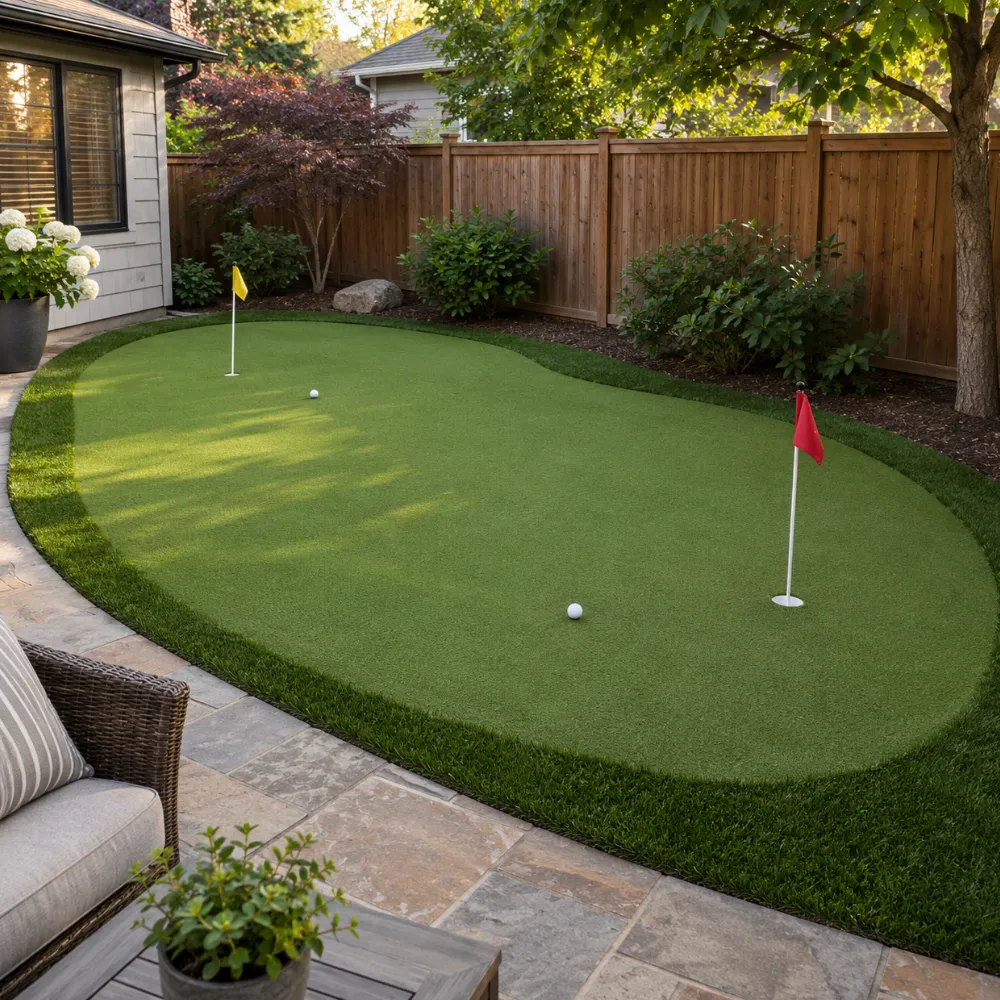
For a US planning benchmark, HomeGuide’s backyard putting green cost guide publishes $15–$40 per square foot installed. A turf-only price pays for the grass. It does not tell you what a finished practice green will cost.
Why can two quotes for the same backyard differ by thousands of dollars? One may include excavation, drainage, and fringe, while the other starts with a prepared base and prices only the putting surface. Comparing their headline totals won’t reveal that difference.
This guide separates complete installation, DIY kits, and turf supply so you can build a budget around the work your site needs. It covers size examples, ground preparation, freight, optional features, and the questions that make written estimates comparable. All prices are in US dollars; local labor and site conditions still determine your actual quotation.
The source dates matter, too. HomeGuide’s visible byline is dated January 31, 2024, despite the page’s 2026 search title. Its figures are a guide, not a new US price survey or an offer to build your green from X-Nature.
Key takeaways
- HomeGuide publishes $15–$40 per square foot installed, with $25–$40 for its small-green category of 100–400 square feet.
- Applying PuttingGreen.com’s advertised $25–$40 standard-install rate to 500 square feet gives an illustrative $12,500–$20,000.
- A DIY kit still needs a compatible base, drainage plan, installation labor, and a confirmed delivery scope.
- Measure putting surface, fringe, and purchased roll quantities separately before comparing quotations.
How much does a backyard putting green cost?
A useful backyard putting green cost estimate starts by defining what you are buying. Complete installation includes a construction service; a kit or turf order leaves more work with the buyer. Treat them as separate budget categories.
Alongside HomeGuide’s broad range, PuttingGreen.com’s pricing guide advertises standard installed greens at $25–$40 per square foot. Its premium systems start at $40 per square foot, and DIY kits start at $3,999. These are that supplier’s advertised offerings, accessed November 23, 2026; they are not X-Nature prices or a market-wide average.
| Budget category | Published reference | What to verify |
|---|---|---|
| Broad installed benchmark | HomeGuide: $15–$40 per square foot | Site work, area definition, and exclusions |
| Standard supplier installation | PuttingGreen.com: $25–$40 per square foot | Exact system, installer scope, and local availability |
| DIY kit | HomeGuide: $5–$20 per square foot; PuttingGreen.com: starting at $3,999 | Included quantities, base preparation, freight, and tools |
| Turf supply only | Obtain a model-specific quotation | Purchased area, accessories, delivery terms, and installation |
Start with the practice surface you need. Explore X-Nature’s putting-green turf options to choose turf for your quote request. Then ask a local firm to price the site work and build.
Don’t turn a kit’s starting price into a finished-project budget. PuttingGreen.com explicitly leaves base preparation and installation with its DIY buyer. Even when a package lists cups or seaming materials, confirm the quantities and charges for your layout.
Backyard putting green cost by size
For a size comparison, the table below multiplies PuttingGreen.com’s advertised $25–$40 standard-install rate by three assumed areas. These are illustrative calculations, not that supplier’s project quotations or surveyed national averages.
| Assumed pricing area | Calculation | Illustrative amount |
|---|---|---|
| 300 square feet | 300 × $25–$40 | $7,500–$12,000 |
| 500 square feet | 500 × $25–$40 | $12,500–$20,000 |
| 1,000 square feet | 1,000 × $25–$40 | $25,000–$40,000 |
Use the table to start your backyard putting green cost plan. Ask whether the priced area is just the putting surface or also includes fringe. Fixed crew and tool costs can push up the price per square foot on a small job.
HomeGuide lists $25–$40 per square foot for its small greens of 100–400 square feet. Even within that guide, using the lowest broad price for a tiny green could leave your budget short.
Count finished area and purchased turf separately
Hypothetical example: Jordan’s cutting plan
Jordan plans a 300-square-foot putting surface plus 90 square feet of fringe, for 390 square feet in all. Assume the cut plan calls for 330 square feet of putting turf and 100 square feet of fringe. Jordan must now price 430 square feet of turf, not 300. These made-up amounts show why the two areas differ; they are not a rule for how much waste to allow.
Ask for a plan that shows roll widths, panel direction, seam sites, and offcuts. A curved green and a plain rectangle may need different amounts of turf, even if they cover the same area. Use the cut plan to check putting green turf cost instead of adding a waste rate with no clear basis.
Keep three areas on the quote: the finished putting surface, the finished fringe, and the amount of each turf you buy. You can then track the cost when you change the shape or widen the fringe.
What changes putting green installation cost?
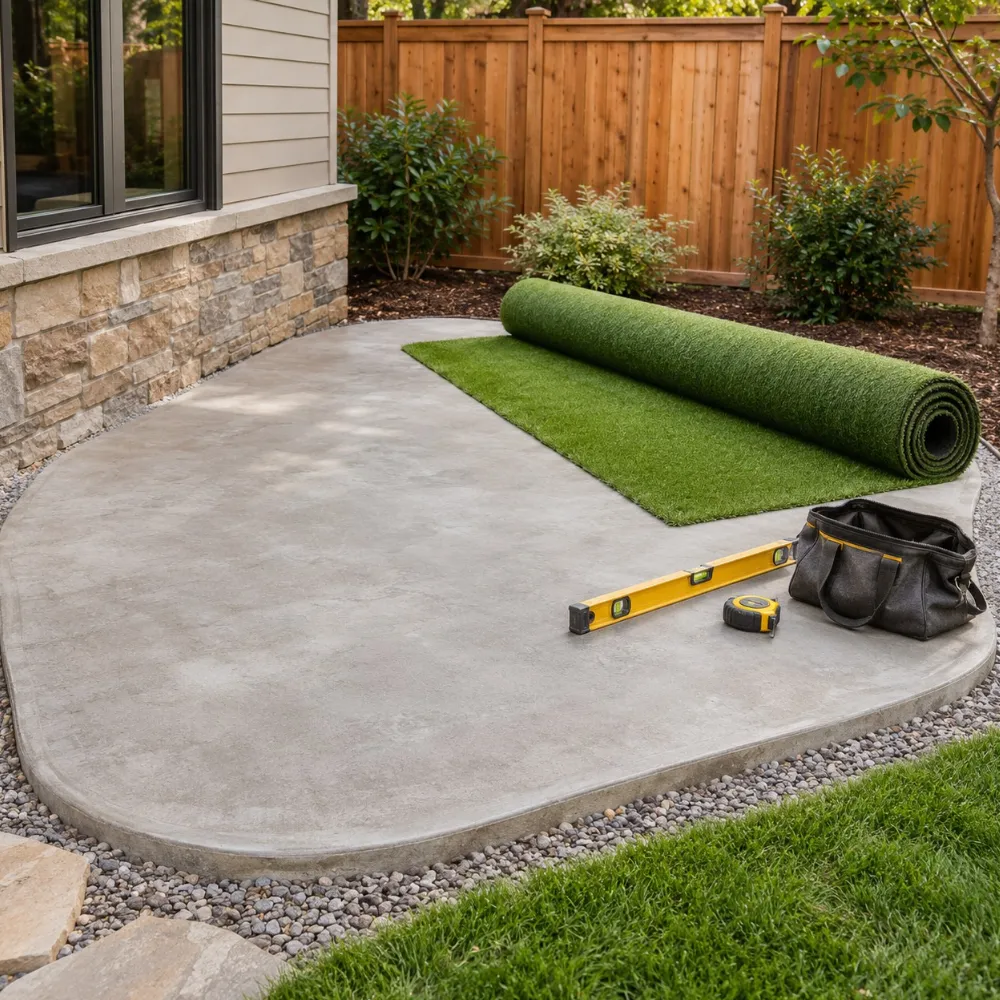
Groundworks and access can change putting green installation cost before anyone opens a turf roll. A site check should show what must come out, how tools and trucks can get in, and where water will drain.
Access, excavation, and disposal
Measure gates and note steps, tight paths, and patios that need care. Ask where trucks can unload and how far the crew can use machines. Moving base stone and soil by hand adds work that a turf price per square foot does not cover.
State who takes out old sod, roots, worn turf, and poor soil. The scope should cover waste removal, truck access, and repairs beyond the green. A quote based on a clear, open site may change once the crew sees your yard.
Base compatibility and drainage
The turf and foundation need an agreed system. X-Nature’s 7016 putting-green turf lists a 16 mm pile height, and its product page describes a hardened foundation such as concrete or asphalt. A different supplier’s aggregate-base instructions should not automatically become the specification for this model.
Have the supplier and installer confirm the proposed foundation, surface preparation, drainage route, and attachment method together. Check whether an existing slab needs repairs or whether water needs a separate outlet. Pile height alone does not establish ball speed, drainage capacity, or suitability for receiving chip shots.
Design and practice requirements
List cups, fringe widths, slopes, lights, and any chipping area before you ask for quotes. Price each extra on its own. You can then cut extras while keeping a clear view of the main build cost.
A putting-only surface and a system intended to receive longer shots need different evaluation. Describe the shots you want to practice and request evidence for the proposed complete system. Don’t assume that a more expensive turf roll automatically supplies the performance you need.
DIY putting green cost versus a professional build
DIY putting green cost includes everything you must buy or hire to finish the job, plus your own time. A kit price and a full-build quote cover different work. Your DIY plan must account for the tasks you take on yourself.
Build the DIY cash budget from the cut plan. Include turf, specified accessories, cups, adhesive or other approved fixing materials, base materials, delivery, equipment rental, disposal, and any specialist work. Add taxes and unloading charges where they apply, then identify which items remain uncertain.
HomeGuide’s $5–$20-per-square-foot kit range is a price for a type of purchase. It cannot price repairs to your slab, new drains, or tool hire for your site. The kit may also use a different turf system from the one you plan to buy.
Professional installation can be useful when the project involves complex shaping, restricted access, uncertain ground conditions, or work you cannot inspect confidently. Ask the installer to explain the proposed system and handover checks. Their involvement should have a written scope, not just a higher headline price.
Compare the work before choosing the price
Hypothetical example: Avery’s two estimates
Assume Avery receives Quote A for $8,400 and Quote B for $9,600 for the same green. A leaves out $900 of waste removal and $700 of drain work; B includes both. Adding those costs brings A to $10,000, so B now costs less. This is a made-up math exercise, not a pair of real customer quotes.
The same approach works for DIY. Price the work you plan to do so you can see which savings depend on your own labor. Track cash and time on two lines. An unpaid weekend does not appear on a bill, but it still affects your choice.
If you split responsibilities between yourself and an installer, agree on the handover point. Before you buy turf, confirm who accepts the prepared base and who corrects it if the surface is unsuitable. Otherwise, each party may price a smaller responsibility than you expect.
How to compare turf supply and installation quotes
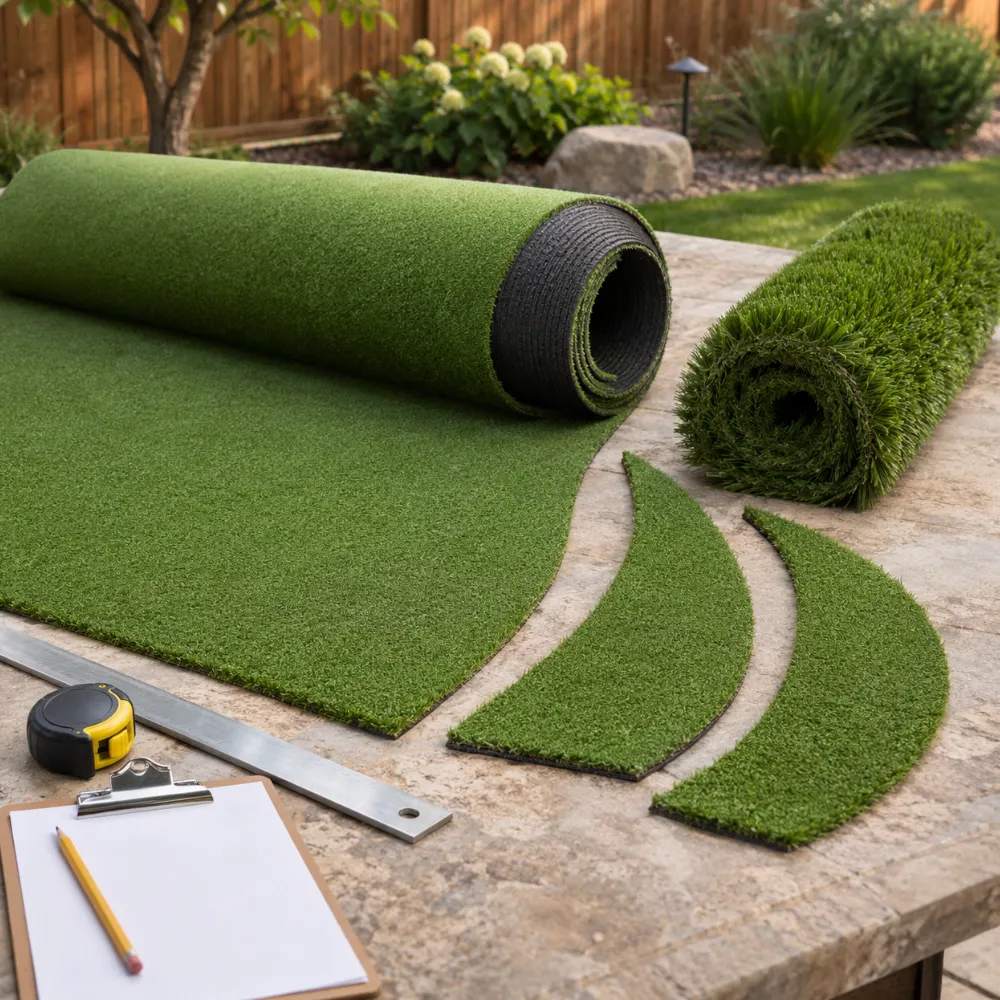
Putting green turf cost is one component of the project budget. For a supply order, compare the amount payable for the required materials at the agreed destination. Then add construction costs without counting an included service twice.
An overseas supplier’s unit price and a local installed price can use different units and delivery assumptions. Confirm square feet versus square meters, currency, purchased quantity, and the named delivery point. For imported goods, establish responsibility for freight, customs clearance, duties, taxes, and final delivery before treating the order as a landed cost.
Use this checklist on each quotation:
| Quote item | Detail to record |
|---|---|
| Area and materials | Putting area, fringe area, purchased roll quantities, model, and accessories |
| Groundworks | Removal, disposal, foundation, drainage work, and restoration outside the green |
| Installation | Seams, fixing method, cups, specified infill, shaping, and finishing |
| Delivery | Destination, freight charges, unloading responsibility, and access requirements |
| Commercial scope | Currency, taxes, payment terms, quotation validity, and stated exclusions |
| Aftercare | Handover inspection, written maintenance instructions, and separate product/workmanship terms |
Use X-Nature’s putting-green selection guide to set out your practice goals and the checks you want to make before you ask for a turf quote. The seller can then price a clear request, rather than guess what the cheapest square-foot offer must include.
Ask who will check and fix a raised seam, uneven ball roll, or a drain problem. Agree on that process before work starts. The turf warranty and the cover for fitting the turf may come from different firms, so get both sets of terms in writing.
A surface sample shows only part of the purchase
When reviewing a sample, keep the budget questions beside it. What base does this product need? What else must you buy and do to fit this system? A good-looking sample cannot answer those questions on its own.
Maintenance, replacement, and common cost questions
Ownership costs continue after installation. Budget for the tasks specified for your chosen system, such as removing debris, cleaning, inspecting seams and edges, and maintaining infill where applicable. Obtain local prices for paid servicing rather than applying another property’s annual maintenance bill to your green.
Use a simple planning equation: ownership budget = initial project cost + upkeep + repairs + eventual replacement. Choose a planning period and price the relevant tasks without assuming a guaranteed turf lifespan. Synthetic turf avoids cultivation tasks such as mowing, but cleaning and repairs still require time or money.
Replacement also needs its own scope. A resurfacing quotation may assume a sound existing base, while a new build includes construction. Before comparing the two, check removal, disposal, base repairs, drainage corrections, and replacement accessories.
How much does it cost to make a putting green in your backyard?
HomeGuide lists a broad US range of $15–$40 per square foot installed. The size table uses a different source, PuttingGreen.com’s listed $25–$40 rate for standard builds. Use these as a guide, then get a quote for your own site that states what is in and out.
Can I build one myself for less?
DIY can cut paid labor if you can do the work. Check turf, base work, hired tools, freight, waste fees, skilled help, and your time. A kit price alone cannot show what you save against a full build.
What is the downside of artificial grass for a putting green?
You pay for an installed system that still needs care and eventual repair or replacement. The surface also needs to match your practice goals; appearance and pile height cannot prove how it will play. Review sample observations, system specifications, maintenance tasks, and installed acceptance checks before choosing.
Does a putting green increase home value?
A rise in resale value is not assured. What buyers want can differ from place to place, so ask a local property expert before you count on a return. Base your budget on the practice and leisure use you expect, rather than a promised payback.
Plan your budget before ordering turf
Start with your practice goals and a measured layout, then identify the construction work needed to support them. Use published prices to frame the discussion, while keeping their dates, geography, and system scope visible. An installed benchmark cannot replace a supplier’s materials quotation or an assessment of your ground conditions.
Keep the putting surface, fringe, and turf you must buy on three lines. Add removal, base work, drains, freight, fitting, tax, and extras only where the quote leaves them out. Check the totals and written scope before you choose which offer suits your needs.
For a supply inquiry, prepare a sketch, dimensions, destination, intended use, and details of any existing foundation. Ask about compatible system requirements and the scope of available support. This information also gives a local installer a more useful basis for a construction estimate.
To develop your backyard putting green cost budget, request a turf quotation from X-Nature, then check its supply scope against the site work and fitting you need.