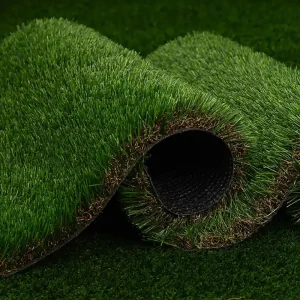
Artificial grass density commonly describes the number of tufting points in a stated area, often reported as stitches or tufts per square metre. Read it alongside gauge, linear stitch rate, pile height, yarn information, and weight definitions; it is not a complete quality or durability rating.
A product sheet may list “20 stitches” without saying over what length. Another may give a heavy product weight without separating yarn from backing. Before comparing those numbers, establish what each one counts and which unit applies.
This guide shows how to organise the fields, check a simple calculation, and ask for missing information. Use the worked example as arithmetic, then return to the actual model documents for your purchase.
Key takeaways
- Separate stitch counts per length from counts per area.
- Convert gauge and stitch-rate units before calculating.
- Do not count individual filaments as if they were tufts.
- Keep yarn weight, total weight, and Dtex distinct.
- Ask for evidence before turning density into a performance claim.
Comparing landscape models? Send X-Nature your model references and specification questions to ask which current product documents are available. Include the intended use and any units that need clarification.
What artificial grass density measures

Distinguish a tufting point from a filament
In a specification, an area count describes how many stated points occur within a defined area. Read the supplier’s definition of stitches or tufts before comparing products. A yarn bundle may contain several individual filaments, so a filament count is a different quantity.
For artificial grass density comparisons, keep the count label attached to the value. If one supplier says tufts and another says blades, ask what each means. Similar-looking numbers are not comparable until their counting basis is clear.
The geometric relationship used below assumes evenly spaced tufting rows and a defined stitch count along each row. It is a way to check consistent specification fields. It is not a substitute for an agreed sampling or laboratory measurement method.
Avoid treating one number as a quality score
More points per square metre means a higher stated area count on that basis. It does not by itself establish wear resistance, softness, safety, drainage, or expected service life. Ask which evidence supports any additional claim.
Use artificial grass density as one construction field in a comparison table. Keep appearance preferences and performance reports in separate columns. That prevents a higher count from becoming an unsupported promise about the finished installation.
For the full purchasing sequence, use the landscape artificial grass buying guide. This article focuses on specifications and units rather than the whole site, quotation, and delivery process.
Read gauge and stitch-rate units first
Gauge describes spacing between rows
Purchase Green’s definitions distinguish gauge as row spacing, stitch rate as a count over a fixed length, and face weight from total weight. It is a supplier’s terminology reference, not an independent certification of another manufacturer’s product. Its own backing-weight additions should not be transferred to X-Nature models.
When checking artificial grass density, first record gauge with its unit. A fraction of an inch and a value in millimetres need conversion before they enter the same calculation. Do not drop the unit and treat the fraction as metres.
For artificial grass density checks, ask whether the gauge value is nominal and what tolerances apply to the supplied specification. Keep any answer with the document reference. A rounded catalogue figure should not be presented as an exact measurement of every part of a roll.
Stitch rate needs a stated length
In artificial grass density comparisons, a stitch rate of 18 per 10 cm is not the same as 18 per metre. The first corresponds to 180 per metre under the same counting convention. A bare value such as “18 stitches” leaves the denominator missing.
For artificial grass density work, write the full unit before calculating. If the source does not define it, request clarification. Do not guess the missing length because another supplier uses that format.
| Field | Meaning to confirm | Example of a clear unit |
|---|---|---|
| Gauge | Spacing between adjacent rows | Inches or millimetres |
| Linear stitch rate | Count along a defined row length | Stitches per 10 cm |
| Area count | Defined tufting points in an area | Stitches per m² |
| Filament count | Individual strands on a stated basis | Filaments per tuft, if specified |
Illustrative scenario: A buyer receives two sheets that both say “18 stitches,” but only one defines the length. The buyer asks for the missing unit before comparing them. This fictional example shows a document check, not a supplier error or a customer outcome.
Calculate artificial grass density with stated assumptions
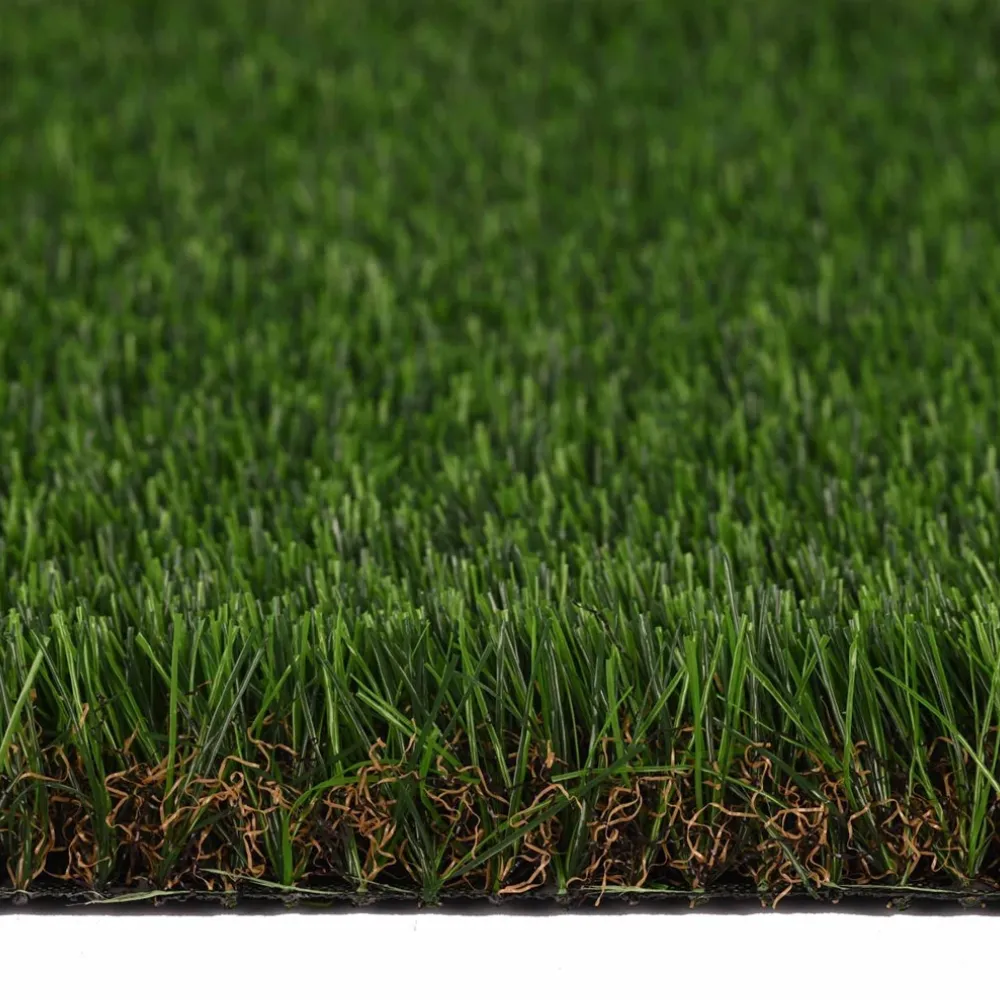
Convert to a common length basis
For an evenly spaced construction, the specification check is:
Area count = rows per metre × stitches per metre along a row.
Rows per metre are found by dividing one metre by the row spacing in metres. Use the defined linear stitch rate for the other factor. State the counting convention so a tuft, stitch, and individual filament are not silently interchanged.
In artificial grass density calculations, show each conversion rather than entering an unexplained result. A reviewer should be able to identify the input document, units, formula, and rounding. Keep theoretical arithmetic separate from actual sampling results.
Follow a worked arithmetic example
Illustrative calculation: Assume a nominal gauge of 3/8 inch and 18 stitches per 10 cm, with one counted tufting point per stitch. These are hypothetical inputs, not a specification or test result for HBA40.
| Step | Arithmetic | Result |
|---|---|---|
| Convert gauge | 3/8 × 25.4 mm per inch | 9.525 mm |
| Express gauge in metres | 9.525 ÷ 1,000 | 0.009525 m |
| Find rows per metre | 1 ÷ 0.009525 | About 104.987 rows/m |
| Convert linear rate | 18 × 10 | 180 stitches/m |
| Multiply | 104.9868766 × 180 | About 18,898 stitches/m² |
The result is approximately 18,900 points per square metre when rounded to the nearest hundred. It follows from the assumed inputs and counting convention. It does not show how a particular roll will perform or what an independent test would report.
Handle differences without inventing a cause
If your artificial grass density calculation differs from a supplied figure, check the units and rounding first. Then ask about the stated tolerances, counting convention, and measurement basis. Do not diagnose a production defect from the arithmetic alone.
Record the question beside the two figures. Keep the supplier’s response and any revised sheet with the original file. An unresolved difference should remain visible until the responsible reviewer has the information needed for the decision.
Separate density, Dtex and weight
Keep the quantities in their own columns
For artificial grass density review, note that Dtex describes yarn linear mass: grams per 10,000 metres of the defined yarn. It does not directly count tufting points per square metre. Confirm the yarn or bundle basis used by the supplier before comparing values.
In artificial grass density documents, face or pile weight and total product weight also need clear definitions. Ask what is included in each reported figure. Do not compare a yarn-weight value with a total that includes backing and coating as though they measured the same thing.
The GAA’s 2022 synthetic turf guide discusses carpet specifications as separate construction properties, including stitch arrangement and pile weight. Its context is Gaelic sports facilities. It does not set a landscape purchasing minimum or establish a service life for your proposed model.
Do not infer density from total weight alone
For artificial grass density review, a weight figure without the construction fields leaves too many unanswered questions. Ask for gauge, linear stitch rate, pile height, and the weight definition. Do not reverse-engineer a missing stitch count from total product mass.
Two products can differ in several construction fields at once. Compare the recorded values rather than attributing every observed difference to a single one. If you need a measured property, request the relevant report and check its scope.
Use the 30 mm versus 40 mm comparison for the height decision. Here, the useful distinction is that height, yarn information, mass, and area count answer different questions.
Illustrative scenario: One offer lists a total weight while another lists yarn weight. The buyer requests matching definitions instead of ranking the products by the larger figure. This fictional example does not claim a price, durability, or quality advantage.
Compare actual landscape product documents
Use HBA40 as a labelled example
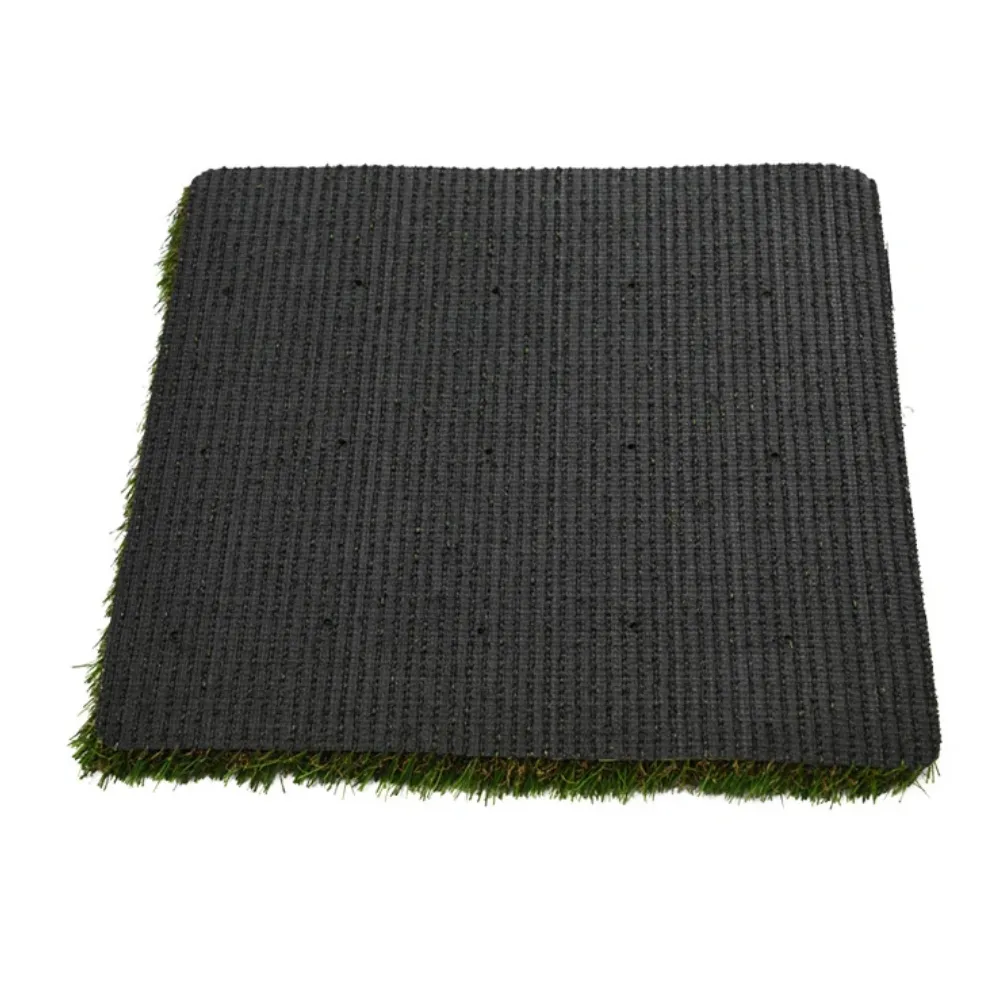
The HBA40 product page publishes a 40 mm pile height, 3/8-inch gauge, 21,000 stitches per square metre, XPU back coating, and a weight of 2.84 kg per square metre. These are manufacturer-published fields; confirm the current order specification before relying on them for supply.
For this artificial grass density example, keep the stated 21,000 stitches/m² as the supplier’s area-count field. The table does not independently measure it. Nor does the weight label establish how much of the product is yarn.
The material description “PE+PP/13000” needs its own clarification if you plan to use the numeric suffix in a technical comparison. Do not assign it a Dtex unit without confirmation. A familiar format is not a reason to fill in a missing definition.
Identify what the sheet does not tell you
An area count and gauge may allow a theoretical reverse calculation under stated assumptions. That is not the same as a published or measured linear stitch rate. Label any such arithmetic clearly, or ask the supplier for the original field instead.
In an artificial grass density enquiry, request the relevant definitions, tolerances, and document version. Ask which fields belong to the exact quoted model. Keep the sample and quotation references connected to that same identity.
Use the landscape grass category to identify candidates, then compare their actual sheets. Do not treat category-level application or performance language as a complete technical dossier for each model.
For clarification, send X-Nature the model code, supplied value and missing unit. A precise question makes it clear whether you need a definition, a current specification, or a supporting document.
Build a usable supplier comparison
Keep unknowns visible
Copy the artificial grass density fields into a comparison sheet with a source reference for each value. Write “not supplied” where information is missing. Do not replace an unknown with zero or a value borrowed from a different product.
| Review item | Model A | Model B | Open question |
|---|---|---|---|
| Exact model and sheet version | Enter reference | Enter reference | Same quoted product? |
| Gauge and unit | Enter value | Enter value | Nominal basis and tolerance? |
| Linear stitch rate and length | Enter value | Enter value | Counting convention clear? |
| Area count and unit | Enter value | Enter value | Calculation or measurement? |
| Pile height and yarn definition | Enter fields | Enter fields | Comparable quantities? |
| Weight and included components | Enter definition | Enter definition | Yarn or total product? |
| Claimed performance | Enter supporting file | Enter supporting file | Relevant model and conditions? |
This is an editorial buying aid, not a test form. Adapt it to the documents actually available. Assign each open question to a person and retain the response with the affected row.
Compare appearance and evidence separately
When reviewing artificial grass density, view labelled samples under consistent conditions if appearance matters to the purchase. Record your preference without translating it into a durability or safety result. A visual impression of fullness does not independently verify the printed area count.
Keep artificial grass density in the wider context of intended use, care, installation, and relevant performance evidence. Ask for the current instructions and reports needed for the actual project. No universal density threshold in this guide approves a product for every garden, pet area, or play space.
Close the artificial grass density review with the selected references and remaining conditions. The next person should be able to trace the decision back to the files, rather than relying on a single “high quality” label.
Questions buyers ask about turf density
Is higher artificial grass density always better?
No. A higher stated count describes more defined points in the same area, on the same basis. It does not establish every property of the product. Compare the complete specification, intended use, sample preference, and relevant evidence.
Why can two products with the same height have different weights?
Ask about their yarn, stitch arrangement, backing, and weight definitions. Height alone does not identify the complete construction. Establish what each mass figure includes before drawing a conclusion from the difference.
Can I calculate density from total weight?
Not from total weight alone. Request gauge, a defined linear stitch rate, and the relevant counting basis for an area-count check. Keep that calculation separate from performance testing and actual measurements.
What should I ask when a sheet only says “20 stitches”?
Ask over what length the stitches are counted and what constitutes one stitch in that document. Request the full unit and model reference. Do not assume it means per 10 cm simply because another sheet uses that format.
Does a difference between my calculation and the sheet prove a defect?
No. First check conversions, rounding, nominal values, tolerances, and counting conventions. Ask the supplier to explain the difference. Record what is resolved and what still needs evidence before treating the figures as comparable.
Does a dense sample prove long life or safe use?
No. Request evidence for the particular claim, model, and application. A construction count or a preferred feel does not establish a lifespan, certification, or approval for an unseen installation.
Use artificial grass density to understand the construction, not as a shortcut around the rest of the specification. Contact X-Nature with your model shortlist, intended use and remaining document questions to discuss the information available for your project review.