Introduction
When buyers compare artificial turf for sports fields, density is often one of the first specifications they consider. Sports fields must withstand repeated foot traffic, outdoor exposure, routine maintenance, and the demands of different sports. That makes density an important factor during product selection.
This guide explains why density matters, how to assess whether high-density artificial turf is suitable for a sports field, and how buyers can use the specifications of DJK50 when comparing products.
What Is High Density Artificial Turf?
High density artificial turf has a relatively high number of stitches per square meter. As a result, more turf fibers are distributed across the same area. Density is usually measured by the number of stitches per square meter. A higher stitch count means more fibers are installed within a given area.
Density is different from pile height, fiber material, and gauge. These specifications describe different aspects of the turf and should not be treated as interchangeable. Density mainly indicates how many stitches are used within a specific area and how closely the turf fibers are distributed.
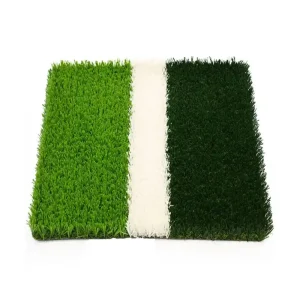
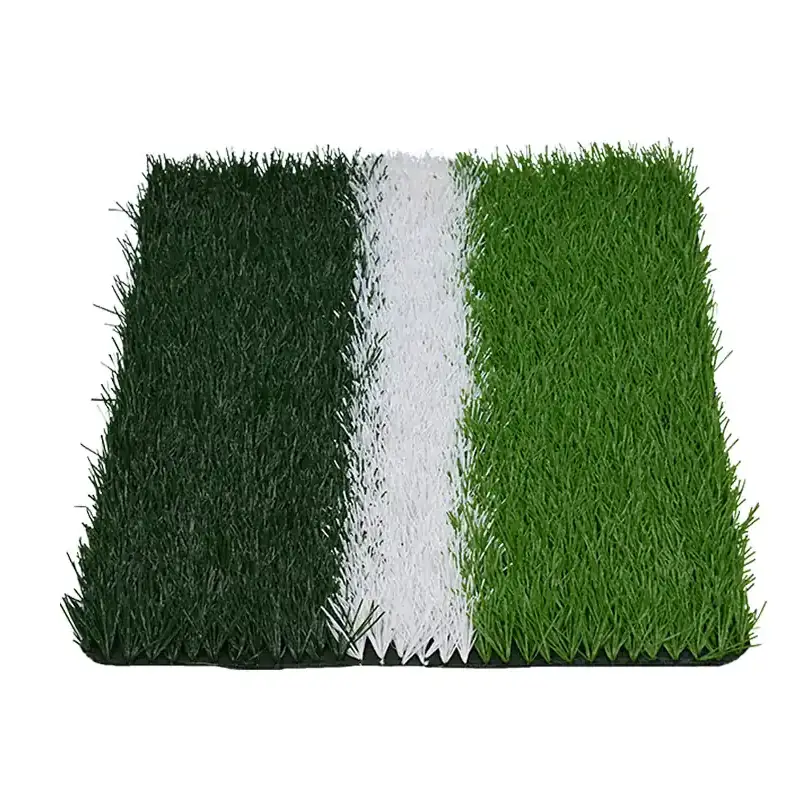
The term “high density” refers to this relatively close fiber arrangement. It helps create fuller surface coverage with fewer visible gaps. Compared with lower-density turf, it generally gives the field a fuller and more uniform appearance.
Why Does Density Matter?
A higher density means more turf fibers are installed within the same area. This can contribute to a more consistent surface feel and recovery. For high-intensity sports such as football and rugby, a well-structured turf surface can help absorb some of the impact when players land or move across the field. It can also provide a more consistent underfoot feel.
A denser fiber structure can help keep infill in place. This matters on fields that receive frequent foot traffic. When the infill remains more evenly distributed, players can maintain a more stable and consistent footing.
Density also contributes to the overall playing experience. Sufficient fiber coverage can support more consistent ball movement and rebound. For sports fields, this helps create a more predictable playing surface.
Durability is another consideration. A dense turf structure provides greater surface coverage, which can help the turf withstand repeated use and abrasion. It can also reduce the amount of exposed backing between the fibers.
However, density should not be used as a standalone measure of overall turf performance. Other specifications also affect how a product performs in a specific application.
What Makes High-Density Artificial Turf Suitable for Sports Fields?
1. How Does Density Affect Surface Coverage?
Density is an important specification when selecting artificial turf for sports fields because it shows how many stitches are installed per square meter. It also gives buyers a useful reference for understanding how the turf fibers are distributed across the surface.
As the stitch count increases, more fibers are arranged within the same area. This creates fuller and more continuous surface coverage. For football training fields and five-a-side football pitches that see frequent use, consistent coverage can be particularly useful.
In simple terms, density answers one key question: How closely are the turf fibers distributed across the surface?
High density artificial grass can make the turf look fuller and reduce visibly sparse areas. However, it does not determine the performance of the entire turf product on its own.
2. What Other Structural Factors Should Be Considered?
A sports field needs more than high density alone. The turf should have a balanced combination of structural specifications that suits the intended application.
Pile height determines the overall height of the turf. Fiber material affects the basic characteristics of the grass fibers. Gauge describes the spacing between stitch rows. The backing and coating form the structure beneath the fibers.
If buyers focus only on density, they may overlook other specifications that are equally relevant. The better question is not simply, “Which product has the highest density?” Instead, buyers should ask, “Does the density work well with the rest of the turf structure for this application?”
Different sports place different demands on a field. Football training, five-a-side football, rugby, hockey, and multi-purpose fields can vary in terms of use, traffic levels, and maintenance requirements.
For this reason, no single density value is ideal for every sports field. A better approach is to identify the sport and expected level of use first. Then compare density with pile height, fiber material, gauge, and backing. This makes it easier to determine whether a product is simply higher in density or actually better suited to the application.
Why Is the DJK50 Structure Suitable for Sports Field Projects?
1. A Specification Package That Matches Sports Field Requirements
Density is an important parameter when selecting sports artificial turf. However, the overall structure must also suit the intended use.
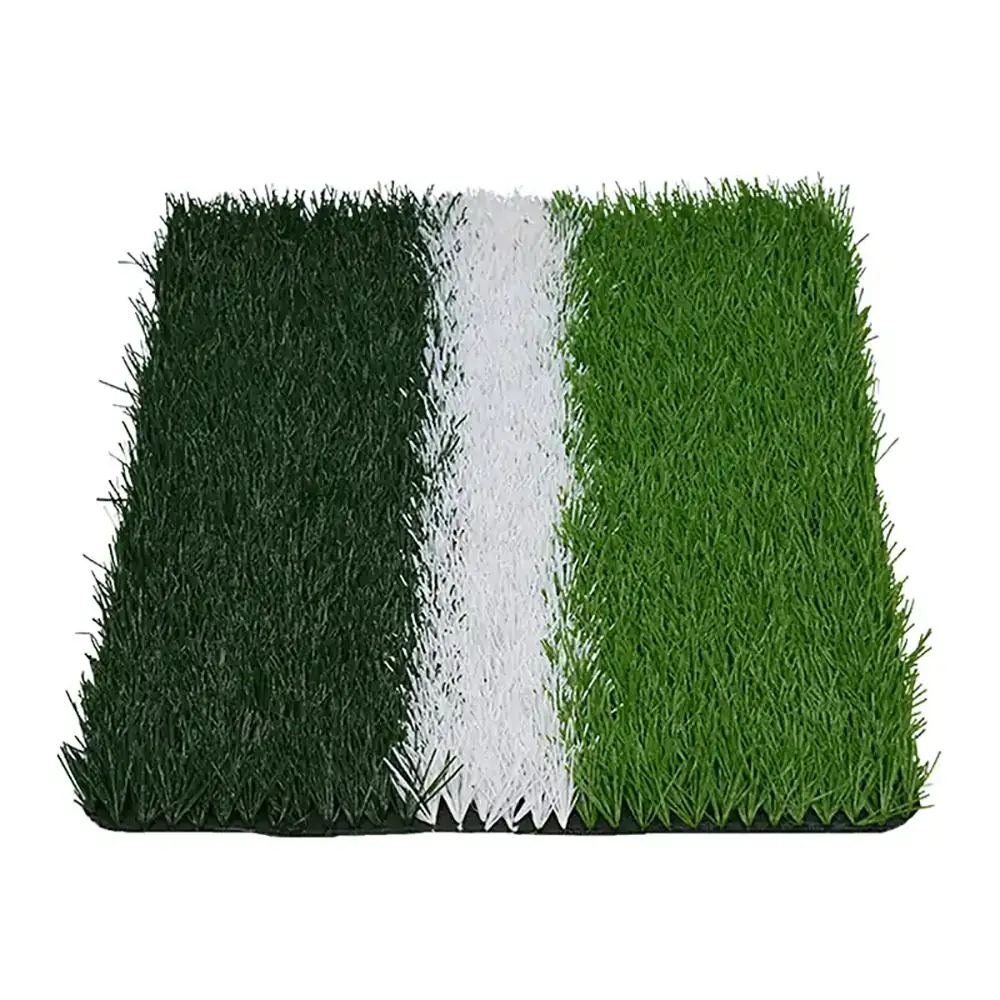
The DJK50 features PE/9500 fiber, a 50 mm pile height, a 5/8-inch gauge, and a density of 10,500 stitches/m². Its backing structure includes an XPU coating, an anti-aging backing, and a tear-resistant reinforcing mesh.
Each specification describes a different part of the turf. Together, they give buyers a clearer basis for product comparison.
The 10,500 stitches/m² density indicates a relatively high stitch count within each square meter. The 50 mm pile height defines the overall turf height. The 5/8-inch gauge describes the spacing of the stitch rows.
When these specifications are considered together with the PE/9500 fiber and reinforced backing structure, buyers have a more complete basis for evaluating the product. This is particularly useful for projects such as football training fields and five-a-side football pitches.
2. A Reinforced Backing Structure for Outdoor Use
Sports fields are exposed to outdoor conditions for long periods. Buyers should therefore look beyond the surface and consider the backing structure as well.
The DJK50 uses a black-and-green anti-aging backing with a tear-resistant reinforcing mesh. It also features an XPU coating. These details give buyers a clearer view of the structure beneath the turf fibers.
The product information also lists UV resistance, heat insulation, flame resistance, automatic drainage, aging resistance, and wear resistance. These characteristics are relevant to sports fields that remain outdoors for extended periods.
3. Suitable for a Range of Sports Field Applications
The intended application is another important factor when selecting artificial turf. Buyers should first identify the type of field they are building. They can then check whether the turf specifications match that use.
DJK50 is designed for applications including five-a-side football pitches, football training fields, rugby fields, hockey fields, and multi-purpose sports fields. It can also be used in sports clubs and gyms, school and kindergarten play areas, and commercial activity venues.
This gives buyers a practical starting point. They can begin with the intended application and then evaluate the turf structure.
DJK50 is supplied in 4 m-wide rolls with customizable lengths. Its weight is 1.7 kg/m². These specifications are relevant to transportation, handling, cutting, and installation planning.
For large sports field projects, roll dimensions can affect how the material is transported and handled on site. Installation teams also need to consider how easily the rolls can be laid out and cut.
For this reason, the value of DJK50 is not based on its 10,500 stitches/m² density alone. Buyers can evaluate its overall structure, outdoor characteristics, application range, and roll configuration as part of the same procurement process.
4. Key DJK50 Specifications and Their Procurement Value
| Specification | DJK50 Parameter | Why It Matters in Procurement |
| Fiber Material | PE/9500 | Helps buyers understand the basic fiber structure and compare it with the requirements of the target sport |
| Pile Height | 50 mm | Confirms whether the overall turf height meets project requirements |
| Gauge | 5/8 inch | Describes the fiber arrangement and should be evaluated together with density |
| Density | 10,500 stitches/m² | Indicates the number of stitches per square meter and helps assess surface coverage |
| Coating | XPU | Helps buyers evaluate the structure beneath the turf fibers |
| Backing | Anti-aging black-and-green backing + tear-resistant reinforcing mesh | Provides information about the backing and reinforcement structure |
| Weight | 1.7 kg/m² | Useful for transportation, handling, and installation planning |
| Roll Size | 4 m wide × customizable length | Helps with transportation, cutting, and on-site installation planning |
The main reason to choose DJK50 is not simply its high density. The product combines density with pile height, fiber type, gauge, coating, and backing specifications. It is also designed for a range of sports field applications.
For buyers, these details provide a more complete basis for evaluation. Instead of focusing on one number, project teams can assess whether the full specification package matches their needs.
The final selection should still be based on the specific sport, expected level of use, base conditions, and installation requirements.
FAQ
1. Is higher-density artificial turf always better for sports fields?
Not necessarily. Density is important, but it should be evaluated together with fiber material, pile height, gauge, backing, installation conditions, and the intended sport.
For procurement, choosing a product that matches the actual field requirements is more important than simply selecting the highest density.
2. What is the density of DJK50 sports turf?
According to the provided specifications, DJK50 has a density of 10,500 stitches/m². It also features PE/9500 fiber, a 50 mm pile height, a 5/8-inch gauge, and an XPU coating.
3. What sports can DJK50 artificial turf be used for?
The listed applications include five-a-side football pitches, football training fields, rugby fields, hockey fields, and multi-purpose sports fields. It can also be used in sports clubs and gyms, school and kindergarten play areas, and commercial activity venues.
4. What should an RFQ for sports artificial turf include?
An RFQ should clearly state the intended application, expected level of use, required turf structure, roll dimensions, base conditions, installation method, and maintenance requirements.
Buyers should also ask the supplier for the latest technical specification sheet. This gives the supplier enough information to confirm whether the proposed product and configuration are suitable for the project.
Conclusion
High-density artificial turf can be a practical choice for sports fields, but density should not be used as a shortcut for judging overall performance.
A better approach is to define the intended application and expected level of use first. Then review the turf structure and installation conditions. This reduces the risk of choosing a product simply because one specification looks impressive while overlooking other factors that matter on site.
For DJK50, the available specifications provide a clear basis for comparison: PE/9500 fiber, a 50 mm pile height, a 5/8-inch gauge, 10,500 stitches/m² density, an XPU coating, an anti-aging backing, and a tear-resistant reinforcing structure.
The listed applications include football, rugby, hockey, multi-purpose sports fields, training facilities, schools, and commercial activities. Before procurement, buyers should still confirm the exact configuration and installation requirements based on the project.
If you are planning a sports field project or looking for durable artificial grass, contact Xiangjing for DJK50 technical information and project selection support. Submit an RFQ with your field requirements so the team can recommend a suitable configuration for your application.