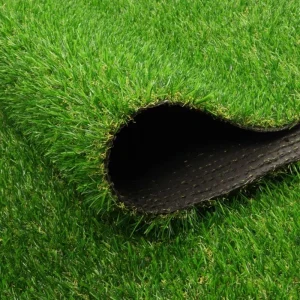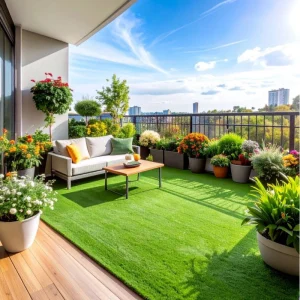
Artificial turf drainage needs water to pass through the turf backing and base, then soak into suitable soil or reach an approved outlet. A fast-draining turf sample can still leave you with a puddled lawn if the water has nowhere to go underneath it.
If rain keeps your lawn out of use, replacing the grass can look like the obvious fix. Yet the blockage may sit below the surface, beside an edge, or farther along the drainage system. Buying another roll before finding that blockage can leave the same problem in place.
This guide explains how to trace the water path, choose layers that work together, and investigate artificial turf drainage problems before ordering repairs. You’ll also learn what to ask about test reports and how to check the finished work. Engineering sources support this guide; the named examples are fictional teaching scenarios. Whether you’re planning a garden or managing a larger site, start with what happens to the water after it leaves the grass.
Key Takeaways
- A permeable turf backing cannot overcome a blocked base or a drainage system with no working outlet.
- Soil infiltration and discharge through pipes are different water routes; check which route your site uses.
- Fine particles, local settlement, and blocked drains can each cause puddles and need different repairs.
- Test claims should identify the exact turf and assembly; a sample demo does not prove storm capacity.
How artificial turf drainage works
Follow the water through each layer
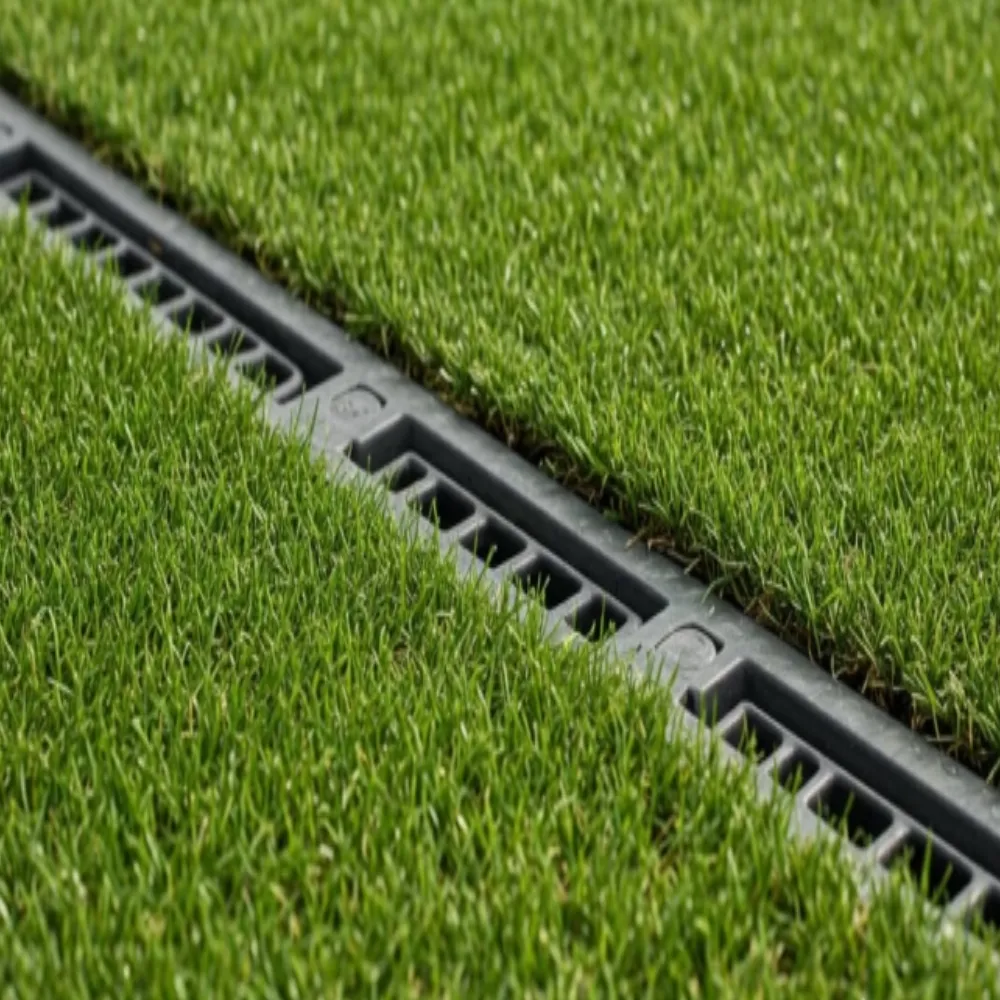
Outdoor turf lets rain pass through holes, slots, or a permeable structure in the turf backing. Infill, when specified, sits between the grass fibers and forms part of that water path. Below the grass, the base layer supports the surface and provides space for water to move.
The ground below that base is the subgrade. If the soil can accept enough water under the site’s conditions, part of the flow may soak into it. Where that route is insufficient, the design may collect water and carry it toward an approved discharge point.
Artificial turf drainage therefore has two separate questions: can water enter the surface, and can it leave the layers below? A drainage system needs to answer both. Water moving through the turf backing has passed only the first stage.
For a garden project, compare landscape artificial grass with your proposed base and water route in mind. Ask for information on the selected product rather than judging its drainage from a photograph.
Separate artificial grass drainage routes
Infiltration means water enters the soil. Collection pipes instead move water elsewhere; they don’t prove that the ground absorbs it. Artificial turf drainage can leave a lawn dry while its drainage system sends water into a downstream pipe network.
The US EPA’s rain-garden overview describes planted areas that collect runoff and let it soak into the ground. Such an area still needs suitable soil, space, and siting. That older overview explains the concept; current local guidance must govern a real installation.
Plan artificial turf drainage around your site
Start with levels, soil, and incoming water
Map artificial turf drainage before choosing a drainage system: record where water comes from and where it can go. Include runoff from paving, roofs, higher ground, and neighboring beds. These flows may bring both extra water and fine soil onto the turf.
Ask the installer or designer to assess existing low spots, soil conditions, wet periods, and the planned outlet. A shallow pipe cannot discharge by gravity into a connection above it. Likewise, adding gravel over slow-draining clay creates storage space but does not make the clay accept water faster.
Artificial grass drainage planning also needs a route for storms that exceed the design capacity. Confirm that overflow will not be directed toward buildings or adjoining property. Locate buried pipes and cables before excavation, and establish which connections need permission.
Hypothetical scenario: Alex’s enclosed garden. Alex plans a 5 m-long lawn between a patio and a raised border. They initially focus on turf backing holes, then notice that the proposed base ends against solid edging. In this fictional example, the installer flags the missing discharge route before ordering grass.
Alex asks for revised levels and an outlet detail rather than assuming a different roll will solve it. The outcome is a clearer project brief, not a claimed installation result.
Treat concrete and decks as a different case
Artificial turf drainage over concrete relies on water moving across the hard surface to a drain or open edge. The turf backing can let water through, but the slab below does not become a soil infiltration area.
For artificial grass drainage over paving, a suitable drainage layer may keep a sideways water path open. Confirm its capacity under the planned load, its connections, and access for cleaning. Keep existing outlets accessible, and don’t drill a slab, roof membrane, or waterproof layer without an approved detail.
Set artificial turf drainage levels from a survey. For illustration, a 1% fall means 10 mm per metre, or 50 mm across 5 m. This arithmetic explains slope; it does not prescribe the right gradient for your lawn, deck, or sports surface.
Choose a compatible base and drainage system
Balance support with artificial grass drainage
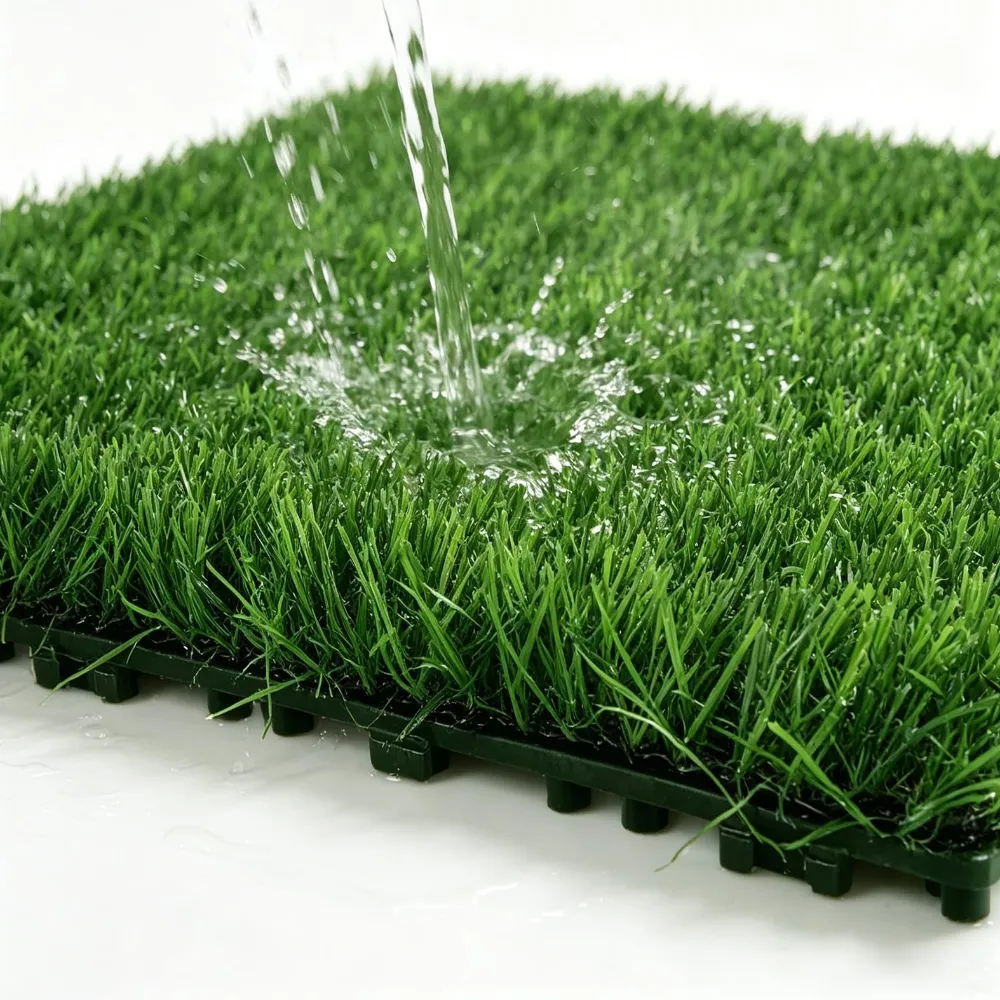
A base needs to support use while letting water move through it. Its stone sizes, fine-particle content, depth, and compaction all affect the finished result. Ask for the specified material and installed condition, rather than accepting a trade name alone.
In SGH’s drainage-investigation brief, Aaron Lewis identifies stone grading, fines, and site work as possible drainage problems. The 2018 brief also explains how runoff can carry particles that clog the turf backing or its holes. These mechanisms help explain why clean materials and control of incoming sediment matter.
Don’t specify artificial turf drainage by copying one base depth from another climate. The designer should connect base support, water storage, soil conditions, and discharge capacity. Adding more stone alone may leave the actual blockage untouched.
Put fabrics, pads, and collectors in the right place
Geotextile is a fabric used to keep layers apart or filter fine particles. Its position and type must fit the soils and water path. SGH notes that fabric can impede flow as it collects fine particles; a blanket instruction to put weed fabric anywhere beneath the grass is inadequate.
A shock pad or drainage panel is another layer to check. Water must pass through it or move sideways along it to a working connection. A fast-draining turf backing cannot fix a layer below that blocks water.
For a sports-field example, J-Drain’s product design guide shows lateral drains linked to perimeter collection and an outlet. That connected route is the useful point. Its product dimensions and spacing are not a fixed rule for artificial turf drainage.
Diagnose puddles before replacing the turf
Use the pattern to narrow the investigation
To assess artificial turf drainage, record where puddles form and what happens after rain stops. Note whether nearby drains also overflow. Photos of the same points during a storm help separate a local dip from wider artificial grass drainage problems.
Artificial turf drainage symptoms can have more than one cause. Use the table to plan checks, not to diagnose hidden layers from appearance alone.
| Observed symptom | Possible blockage | Useful next check |
|---|---|---|
| Water sits over a dirty, matted patch | Surface debris or fine-particle buildup | Check approved cleaning methods and where sediment enters |
| A puddle follows one depression | Settlement or incorrect levels | Survey the surface and inspect base support |
| A broad area stays wet | Slow base, subgrade, or another restrictive layer | Compare installed layers with the design and investigate infiltration |
| Water collects beside solid edging | Lateral flow blocked at the boundary | Trace the route through or around the edge |
| Water backs up near a drain | Blockage, damaged pipe, or downstream backup | Inspect accessible outlets; arrange drain investigation if needed |
Match the repair to the failed link
Start artificial turf drainage repairs with simple checks: remove loose leaves, clean grates, and review the installation records. Follow the supplier’s care instructions when brushing or washing. Aggressive pressure washing can move infill or damage the assembly, so check approved methods first.
If artificial turf drainage remains poor, ask a trained contractor to inspect the turf backing, base, and drain route. Lifting a section, testing materials, or surveying pipes may be suitable. Agree the inspection scope before opening a seam or disturbing a waterproof layer.
For dog areas, rinse water adds another flow to manage. Our dog-turf drainage and care guide explains the relationship between drainage, access, and cleaning. A drainable surface still needs a cleaning routine; drainage alone does not remove every source of odor.
On putting greens, repairs must also preserve the planned playing slopes. Use the putting-green turf buying guide when balancing turf selection with play requirements. Simply steepening the surface could change ball behavior while leaving the blockage beneath it unresolved.
Check drainage claims and test the finished installation
Ask what the reported rate measures
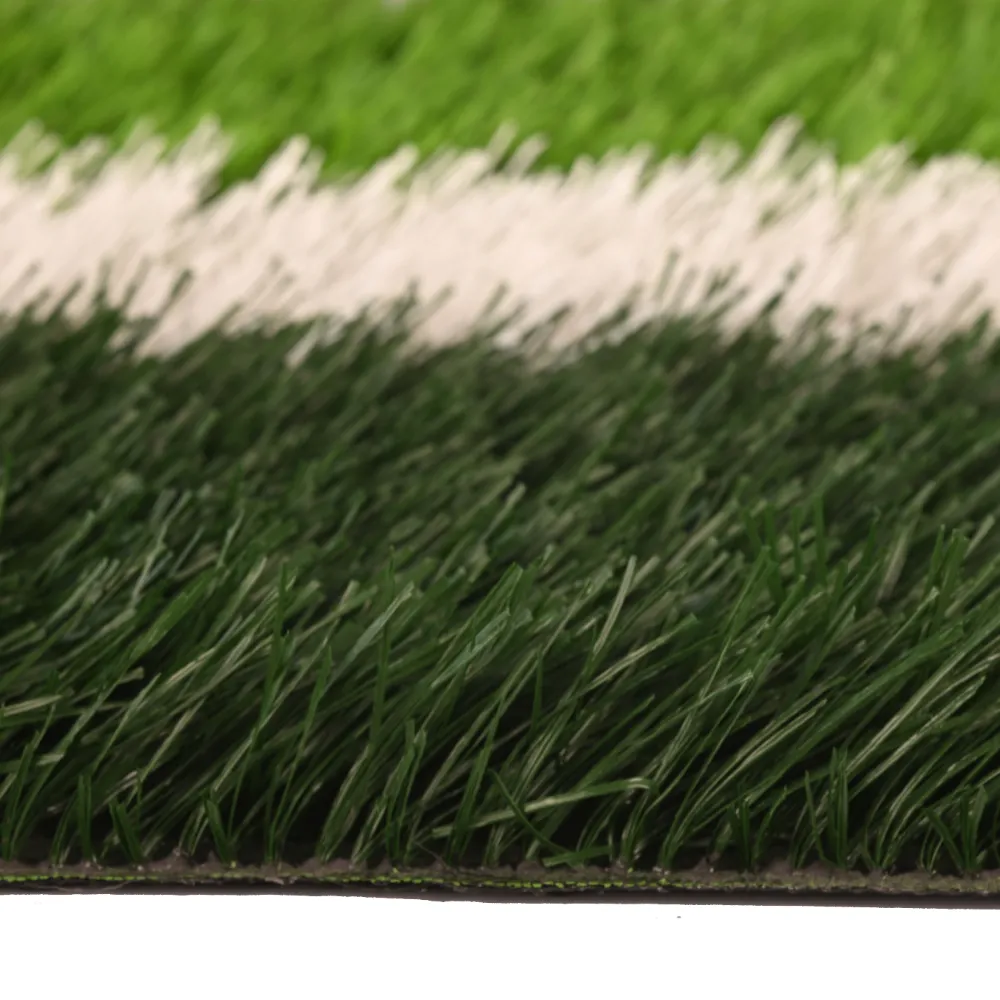
An artificial grass drainage figure in a leaflet may describe flow through a turf backing sample under set test conditions. It may not describe the installed drainage system, including infill, pads, base, soil, and outlet. SGH’s brief distinguishes surface infiltration from specimen permeability and discusses limitations in interpreting tests on infilled systems.
For artificial turf drainage comparisons, request the exact model, test method, units, specimen condition, and tested layers. Ask whether the report includes the planned infill and pad. Also check whether the figure describes water moving down through a layer or sideways under load.
A coating name, pile height, or photo of backing holes is not a measured drainage rate. Apply the same test standard to X-Nature products. If an applicable report isn’t available, leave the performance commitment open rather than turning a general product description into a guarantee.
Before accepting a drainage claim, prepare these questions: Which layers were tested, under what conditions, and how will the finished site be checked? This gives your supplier and installer a concrete basis for discussion.
Put rainfall volume in context
Hypothetical scenario: Morgan’s courtyard. Morgan manages a proposed 40 m² courtyard and uses an illustrative rainfall depth of 50 mm. They calculate 0.05 m × 40 m² = 2 m³, or 2,000 litres, falling onto that area. If the same depth falls in one hour, the average input is about 33 litres per minute.
Morgan adds nearby paving runoff to the questions for their designer instead of selecting a drain from a backing test alone. The example improves the design discussion; it is not a storm-capacity calculation.
Actual artificial turf drainage design also considers storm duration, storage, soil intake, nearby paved areas, and conditions at the outlet. The example sets no local design storm or approved pipe size. A designer must choose the applicable rainfall criteria and check the whole drainage system.
Agree checks before covering the work
Before covering artificial turf drainage work, record the base materials, levels, drain connections, and outlet locations. Keep photos and the as-built artificial grass drainage layout, including access points for the drainage system. Agree the inspection and testing method, conditions, and acceptance criteria before installation begins.
A water check can reveal a blocked path, but one bucket or hose test cannot prove heavy-rain performance. Record the test setup and what you saw. Don’t invent a fixed time for water to clear. After handover, revisit artificial turf drainage during wet weather and keep access points clear.
Artificial grass drainage questions
Does water go through artificial turf?
Yes, water can pass through outdoor turf designed with a permeable backing or drainage openings. The turf backing is only one part of the route. Artificial grass drainage still depends on the layers, soil, and outlet below; water entering the carpet has not necessarily left the installation.
Can I just use gravel for drainage?
Gravel can support water movement and storage, but it is not a complete drainage system by itself. Check its grading, support, separation from soil, and discharge route. Artificial turf drainage over a gravel-filled hollow can still fail when the surrounding ground cannot accept enough water.
Can I just lay turf over dirt?
Laying turf directly over unprepared dirt does not establish reliable support or artificial grass drainage. Soil can soften, settle, or restrict flow. Assess the ground and follow a suitable base design; extra holes in the turf backing cannot fix an unstable or poorly draining foundation.
Can artificial turf go over concrete?
It can be considered where the slab, levels, and outlet suit the chosen assembly. Artificial turf drainage needs a clear sideways water path on concrete. Check the drainage layer, edge details, adhesive pattern, and access to existing drains before covering the surface.
Does clay always need a French drain?
No single drain layout suits every clay site. Assess infiltration, water levels, available fall, and the discharge destination. A French drain needs a drainage system that can collect and move water. It does not make an unsuitable outlet work.
Can turf cover a septic drain field?
Do not assume that it can. Ask the local wastewater authority and system designer whether the proposed cover and installation are allowed. Approval for ordinary artificial grass drainage does not establish suitability over a septic system or authorize excavation, compaction, or changed surface conditions there.
Prepare your artificial turf drainage buying brief
Before requesting prices, gather the facts that determine the water route. Include your location, intended use, area, existing surface, and photos of wet spots. Add measured levels where available, nearby sources of runoff, and the planned outlet. State whether the project is on soil, concrete, a deck, or a waterproof surface.
Ask the installer to explain each layer’s role in artificial turf drainage and how the drainage system will remain accessible. Request applicable test evidence for the selected turf backing and assembly. Agree how materials, levels, connections, and finished drainage will be checked, with responsibilities recorded in the quote.
Good artificial grass drainage needs the right turf, a well-built base, and a working water route. Those details also make competing quotations easier to compare. Keep unresolved performance questions visible instead of accepting a broad promise that a different roll will fix the site.
Send X-Nature your project details to discuss product options and available specification information. Confirm support scope and commercial terms in the quotation, and assess artificial turf drainage as a complete installed system.