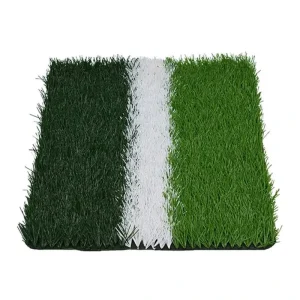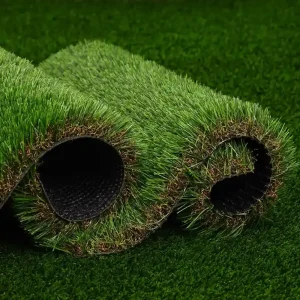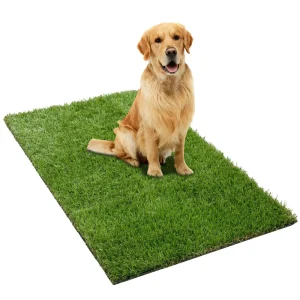
Artificial grass for balcony use can work well on a sound, well-drained floor when the building permits it. Choose the turf together with its drainage layer and fixing method, and check the full installed height before buying.
The most useful starting point is the floor beneath the grass. A soft sample tells you little about whether rainwater will reach the outlet or the balcony door will open. Those details decide how practical the finished space will be.
If you want a greener place to sit without growing a lawn, synthetic turf offers a straightforward visual change. It doesn’t need mowing or fertilizer, but it still needs cleaning and a suitable installation. This guide explains how to compare rolls and tiles, read product specifications, plan drainage, and work out what your project quote should include.
Key Takeaways
- Drainage holes in turf need a clear water path beneath the backing to an accessible balcony outlet.
- Measure turf, backing, and underlay together when checking door clearance.
- Rolls offer a continuous surface; suitable interlocking tiles can make lifting sections for cleaning easier.
- Sun exposure, wind, and the existing floor determine which installation methods are suitable.
- A pet toilet needs a planned collection and cleaning system; decorative balcony turf alone doesn’t provide one.
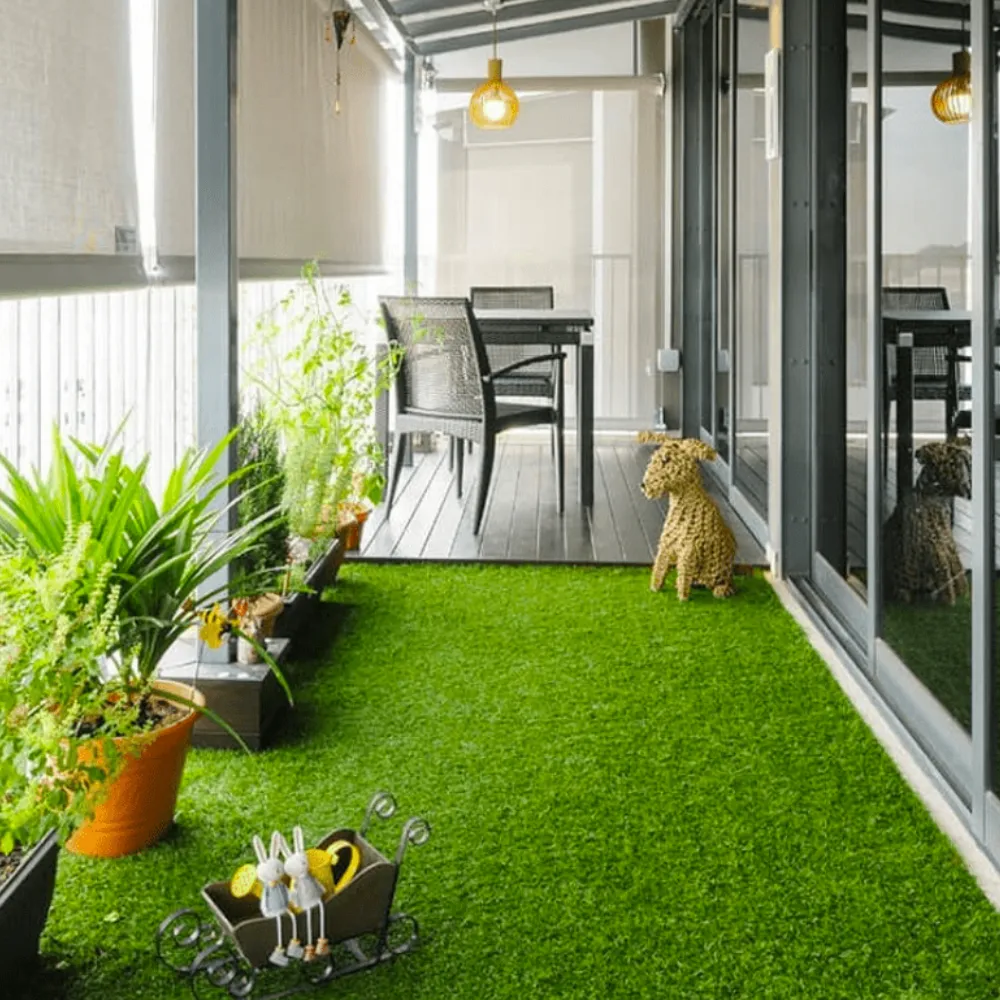
Is artificial grass suitable for your balcony?
Check permission, floor condition, and door clearance
Start with your lease, building rules, or property manager. Ask whether floor coverings are allowed and which attachment methods can be used. Permission to place a removable covering may not include permission to glue it down.
Inspect the floor for standing water, loose tiles, leaks, and damaged coatings. Resolve those problems before covering them. A turf layer can hide a defect and make inspection harder.
Measure below any outward-opening door across its full swing. Include the turf backing, drainage layer, protective layer, and edge profile in the finished height. For sliding doors, keep tracks, drainage openings, and the threshold clear.
Hypothetical planning example: Maya rents a balcony with an outward-opening door. They compare a turf sample together with the proposed underlay and find that the door catches. Choosing a lower complete assembly, or leaving an approved hard-surface strip at the doorway, would avoid buying a covering that obstructs the door.
Once these checks are complete, explore landscape artificial grass and compare samples against your measured space.
Plan for sunlight and exposed edges
Synthetic turf can become hot in direct sunlight. UF/IFAS guidance on synthetic turf discusses excessive surface heat and the need for cleaning. Its findings concern landscape installations; they don’t predict a particular balcony’s temperature.
Plan shade where practical, and check the surface before barefoot or pet use. Ultraviolet (UV) resistance concerns sun exposure and material degradation; it doesn’t establish a comfortable surface temperature. Strong reflections from nearby glazing also deserve attention because concentrated sunlight can damage synthetic materials.
Open balconies need an attachment plan for wind exposure. Loose turf, curled edges, or unsecured tiles can move or lift. The building’s requirements and the complete flooring system should guide the fixing method.
Keep ignition sources away. The London Fire Brigade’s barbecue advice says not to use a BBQ on a balcony. A mat under a grill doesn’t resolve that advice or establish compliance with your local building rules.
How to choose artificial grass for balcony use
Compare rolls and interlocking tiles
Roll turf suits a continuous lawn-like finish and can be cut around corners or columns. Interlocking grass tiles divide the surface into smaller units, which can simplify access beneath them. Check that the selected product is intended for outdoor use on your existing floor.
| Decision | Roll turf | Interlocking grass tiles |
|---|---|---|
| Appearance | Larger continuous areas, with joins where needed | Regular grid of individual units |
| Fitting an irregular edge | Cut backing to the measured shape | Cut or finish perimeter units as instructed |
| Access for cleaning | Plan liftable areas or removable sections | Suitable systems allow individual units to lift |
| Finished height | Turf plus the specified layers beneath it | Grass, tile base, and any required protection layer |
| Removal | Depends on seams and floor attachment | Depends on connectors and perimeter fixing |
| Wind exposure | Requires a suitable securing method | Requires a suitable securing method too |
Peel-and-stick carpet tiles and raised interlocking turf tiles are different products. An adhesive-backed tile doesn’t automatically provide an open drainage space beneath it. Ask for the installation drawing or instructions rather than relying on the word “tile.”
Choose pile height using samples
Pile height means the length of the grass fibers above the backing. Compare a shorter sample with a fuller one to judge cleaning access, feel, and appearance. For a balcony with chairs and frequent foot traffic, moving furniture across the sample is more useful than judging a close-up photograph.
Look at samples from the doorway and in daylight. Turn them in the intended viewing direction, check the color beside your furniture, and brush the fibers by hand. Taller pile creates a different appearance, but height alone doesn’t establish durability or comfort.
Polyethylene (PE) and polypropylene (PP) are common turf fiber materials. Their names don’t tell you the whole product’s performance. Fiber shape, construction, backing, installation, and exposure also matter.
Compare documented product specifications
X-Nature publishes the following specifications for two landscape models. Both product pages list balconies among their applications.
| Published specification | HBA30 landscape turf | HBA40 landscape turf |
|---|---|---|
| Pile height | 30 mm | 40 mm |
| Fiber material | PE + PP | PE + PP |
| Stitch density | 17,800 stitches/m² | 21,000 stitches/m² |
| Back coating | XPU | XPU |
| Published weight | 2.59 kg/m² | 2.84 kg/m² |
| Color description | Four colors | Four colors |
| Published roll size | 4 m × 25 m | 4 m × 25 m |
These are manufacturer-published specifications. A balcony application listing doesn’t approve the complete system for your building. Published turf weight also excludes the rest of the installation, and pile height excludes the backing and underlay.
Use these figures to ask better questions about samples, cut sizes, backing, and installation requirements. Ask for relevant model-specific reports when your project needs documented fire or material performance.
For another comparison of the two models, read the HBA30 and HBA40 guide. Confirm current specifications and project suitability with the supplier before ordering.
Plan drainage beneath balcony artificial grass
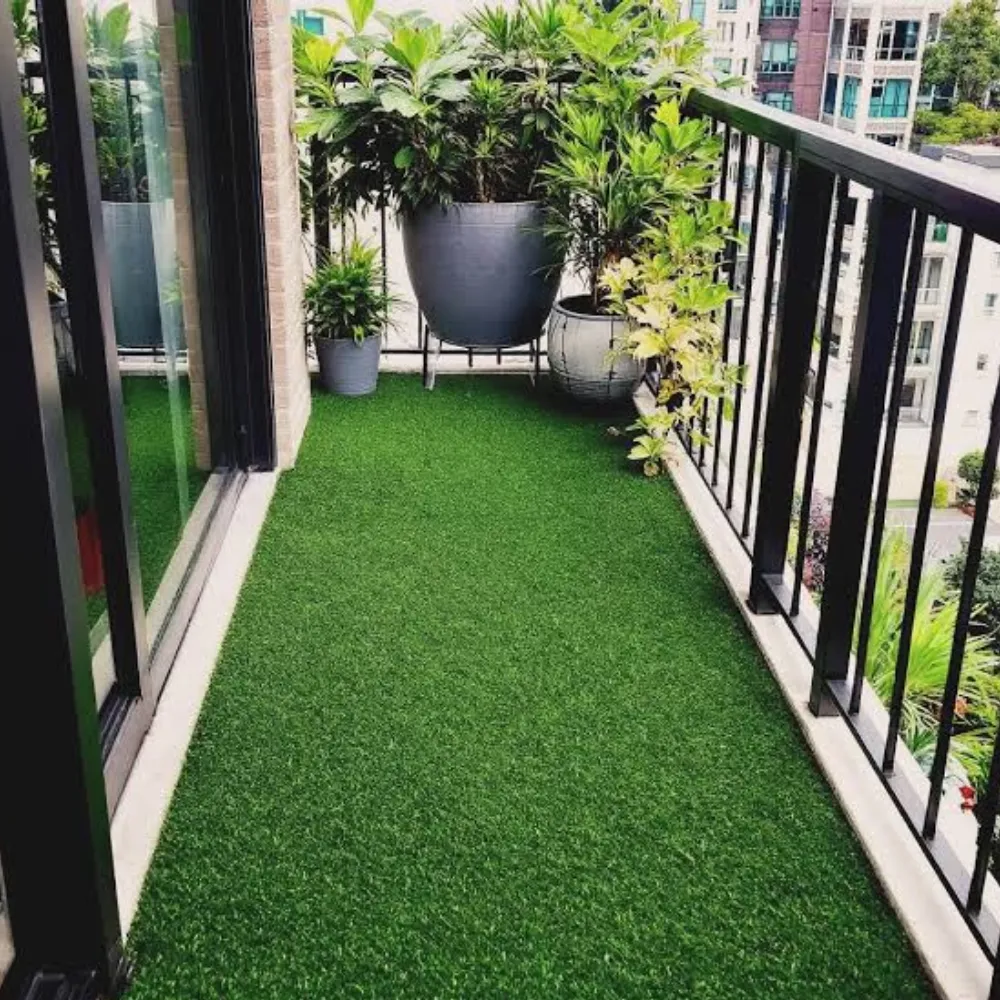
Follow the water from backing to outlet
A practical drainage plan has three stages: water passes through the turf, moves beneath the backing, and reaches the balcony outlet. All three must work together.
Drainage holes address the first stage. On concrete, tiles, or a waterproofed floor, water then needs room to move sideways along the existing fall. A blocked outlet, trapped low point, or adhesive barrier can interrupt that path.
Mark every drain and any overflow opening before planning the layout. Leave them accessible for inspection and clearing. If the floor already ponds after rain, establish the cause before installing turf; a drainage mat cannot repair a failed slope or leaking waterproofing.
Decide whether an underlay belongs in the system
A compatible drainage mat or raised tile base can provide space for water movement. Check how that layer connects to the outlet and whether it requires protection between itself and the existing coating. Soft foam padding alone doesn’t establish drainage performance.
Installer guidance for balcony turf also emphasizes drainage beneath hard-surface installations. Treat that as a planning principle; choose the actual layers with the turf supplier and the person responsible for the balcony’s waterproofing.
Plan maintenance access at the same time. If dirt collects below the surface, you should be able to lift an approved section without dismantling the whole floor. The right drainage arrangement is one you can inspect and clean after installation.
How to install artificial grass on a balcony
Measure and plan the cut layout
Measure the floor, recesses, columns, door sweep, and drain positions. Draw a simple plan showing joins and access points. Confirm the available roll width or tile dimensions before calculating the order.
Hypothetical ordering example: Leo has a rectangular balcony measuring 3 m × 1.5 m, giving 4.5 m² of usable floor. If a supplier offered a 2 m-wide roll sold in a 3 m length, the purchased cut would be 6 m². The remaining strip would be an offcut, so a price per usable square meter would understate the material bill. This assumed width is an example, not an X-Nature stock-size promise.
Keep the pile direction consistent across joined pieces. Check that any proposed offcut can face the same direction before counting it as usable material. A cut plan can reveal waste that an area calculation misses.
Fit the approved system and check the edges
Use the instructions for the selected products and floor assembly. A practical installation sequence is:
- Confirm the system. Agree on drainage, floor protection, seams, and attachment before cutting or applying adhesive.
- Clean and inspect. Remove debris and check the floor, outlets, and waterproofing. Follow the chosen adhesive’s surface preparation requirements where applicable.
- Dry-fit the layers. Position the protection and drainage components, then the turf or tiles. Recheck doors and drain access.
- Trim carefully. Cut turf from the backing side with a sharp blade, protecting the surface beneath it. Keep fibers out of the cutting line.
- Join the turf. Follow the seam tape and adhesive instructions, with the pile aligned. Joining two pieces doesn’t automatically secure them to the balcony.
- Secure the covering. Use the approved method for the floor and wind exposure. Avoid creating barriers across water paths.
- Finish and inspect. Respect adhesive curing instructions, remove loose cut fibers, brush as directed, and check edges, doors, and outlets again.
Don’t drill, nail, or staple through a waterproofed floor without an approved detail. Adhesives and tapes can leave residue or damage coatings, so check compatibility and removal requirements first. Adding sand or heavy planters as improvised ballast also changes the load and doesn’t establish an adequate wind design.
For an exposed or complex balcony, get installation advice before ordering. Access, edge details, and the floor beneath the grass can matter as much as the turf itself.
Cleaning, pet use, and total cost
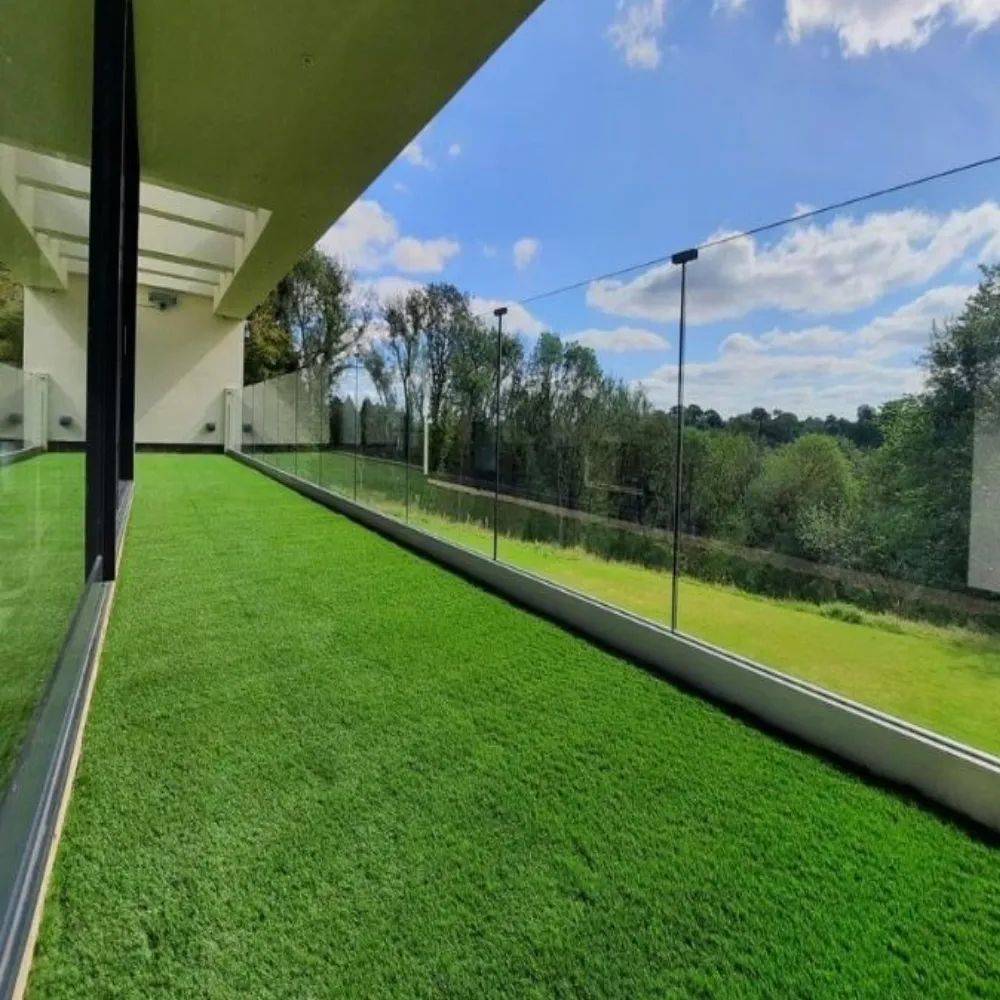
Keep the surface and floor beneath it clean
Remove leaves and loose dirt before they settle into the pile. Use the brush and cleaning method recommended for the turf. For spills, start with a compatible mild cleaner and a small test area, then remove cleaner residue as instructed.
Lift removable sections periodically to check for trapped debris, damp patches, and blocked water paths. Check again after heavy rain or strong wind. Persistent odor or ponding calls for investigation beneath the surface as well as cleaning above it.
Furniture can leave flattened areas. Move items when practical and brush the pile gently as directed; don’t assume every indentation will disappear. Turf reduces lawn care, but it doesn’t remove the need to look after an outdoor floor.
Keep pet waste out of shared runoff
For regular toilet use, consider a removable turf insert over a collection tray with a planned disposal route. That gives you access to clean the insert, tray, and floor. Confirm that the building permits the arrangement.
Remove solid waste promptly and use a compatible cleaning product for urine and odor. Don’t assume rain will sanitize the turf, or wash pet waste toward neighboring balconies and shared drainage. Ask the property manager how cleaning water should be handled.
A “pet-friendly” label doesn’t replace material information, cleaning instructions, or a suitable collection system. Check the surface temperature before allowing pets onto sun-exposed turf.
Compare complete project quotes
Ask suppliers to distinguish the usable area from the purchased quantity. A complete quote should identify:
- Turf or tile quantity, dimensions, and cutting allowance
- Drainage and protective layers
- Seam materials, permitted fixings, and edge finishing
- Delivery, taxes, and installation where applicable
- Removal work and floor preparation, if required
For a small balcony, delivery and minimum cut sizes can affect the total noticeably. Confirm sample availability, order quantities, lead time, and warranty terms directly. Compare quotes with the same included layers and work, rather than comparing the turf price alone.
Questions about artificial grass for balcony spaces
What is the best artificial grass for a balcony?
The best choice fits your floor, drainage, door clearance, exposure, and cleaning routine. Compare outdoor-rated samples and the complete installation requirements. No single pile height or backing type resolves every balcony’s constraints.
Can you lay artificial grass on concrete or tiles?
Yes, suitable turf systems can cover sound concrete or tiles. Check existing drainage and whether the surface is part of a waterproofed assembly. Confirm attachment compatibility before using glue or tape.
Do artificial grass tiles need a drainage mat?
It depends on their base and the existing floor. A raised tile may already provide a water path; a flat adhesive-backed tile may not. Follow the complete system instructions and keep the outlet accessible.
Does fake grass develop mold when it rains?
Damp debris and trapped moisture can allow mold or mildew to develop. A clear water path, cleaning access, and regular debris removal reduce those conditions. Persistent dampness beneath the turf needs attention rather than another surface rinse.
Can renters use removable balcony turf?
They can if the lease or property manager permits it and a suitable removable system is available. Confirm attachment and removal requirements in writing. “Removable” tape may still leave marks, and exposed edges still need secure fixing.
Is balcony grass suitable for dogs?
It can provide a surface for supervised leisure when the material, temperature, and installation suit that use. Regular toilet use needs a separate hygiene and collection plan. Check product documentation and avoid directing contaminated water into shared runoff.
Choose your balcony turf with the floor in mind
Start with permission, the water path, and measured door clearance. Then compare turf samples and choose a system you can secure, inspect, and clean. This sequence helps you assess the finished floor before committing to a color or pile height.
For a useful quotation, prepare a dimensioned sketch and photographs of the existing surface, threshold, and outlets. Include whether the balcony is open or enclosed, how much sun it receives, and whether you need a removable installation. Mention pet use and furniture so the discussion covers cleaning and day-to-day use too.
To discuss artificial grass for balcony use with X-Nature Grass, request a project quote. Ask about suitable specifications, sample availability, cut sizes, and the proposed drainage and attachment arrangement. Those details will help you compare the complete proposal and decide whether it fits your space.