When building or renovating a football field, the turf you choose directly affects player performance, safety, and long-term operating costs. With various models and specifications available on the market, how do you make the right decision? This article breaks down the core selection criteria for artificial turf based on actual field requirements, helping you establish a clear evaluation framework.
Why Choosing the Right Football Turf Matters
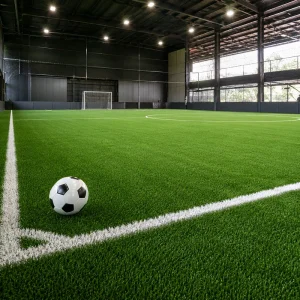
Different football fields serve vastly different purposes. A school sports field is primarily used for after-class activities and team training, with relatively low usage frequency. A professional club training ground may endure over ten hours of high-intensity foot traffic daily. A commercial sports center needs to accommodate multiple sports — football, rugby, hockey — while coping with various weather conditions.
Choosing the wrong turf can lead to a range of problems:
- Increased risk of sports injuries — Insufficient shock absorption exposes players’ joints to excessive impact.
- Reduced game quality — Unstable ball roll and flattened fibers compromise passing and control.
- Higher replacement costs — Low-durability turf may show severe matting and wear within just two to three years.
- Reduced field availability — Poor drainage leaves the field unusable for extended periods after rain.
Selecting the right turf ultimately means finding the optimal balance between safety, athletic performance, and durability, based on the intended use, usage frequency, and budget.
What Is Reinforced Artificial Turf?
Artificial turf can be broadly categorized into three application types: landscape/decorative, recreational sports, and professional athletic. Standard landscape turf and entry-level sports turf typically use basic materials and simple manufacturing processes, suitable for low-frequency, low-intensity environments.
Reinforced artificial turf is designed for high-intensity, high-frequency sports scenarios, with specific enhancements in several key areas:
- Higher-grade fibers — Professional-grade polymer materials offer significantly improved abrasion and aging resistance.
- Greater stitch density — More yarns per unit area provide better support and resilience.
- Stronger backing systems — Tear-resistant mesh and advanced coatings prevent yarn loss and seam separation.
- Superior weather resistance — UV stabilizers and temperature-resistant additives adapt to year-round outdoor exposure.
These reinforcements enable reinforced turf to maintain stable appearance and athletic performance after years of heavy use.
Key Factors to Consider When Choosing Football Artificial Turf
The following seven core indicators form the basic framework for evaluating whether an artificial turf is suitable for football fields.
Pile Height — Why 50mm Has Become the Standard for Football Fields
Pile height is one of the most critical parameters for football turf. Currently, 50mm has become the mainstream choice for professional and amateur football fields because it delivers an ideal overall performance:
- Stable ball roll — The moderate fiber length evenly supports the ball, reducing irregular bounces and directional deviations.
- Good shock absorption — The fibers effectively compress underfoot, absorbing impact and reducing stress on players’ knees and ankles.
- Excellent resilience — Longer yarns recover their upright position more easily after compression, maintaining surface evenness.
Turf that is too short (under 40mm) results in a harder surface with insufficient cushioning. Turf that is too tall (over 60mm) slows down ball speed and affects the fluidity of play. At 50mm, the turf sits at the optimal balance point, which is why this specification is widely adopted by mainstream football venues worldwide.
Fiber Material — How Different Types Affect Performance
The material of the turf fiber determines its feel, durability, and environmental adaptability. Common materials on the market include:
| Material | Advantages | Disadvantages | Best Applications |
| Polyethylene (PE) | Soft and comfortable, abrasion-resistant, UV-resistant, good temperature tolerance | Slightly higher cost than PP | Preferred for professional sports fields |
| Polypropylene (PP) | Lower cost, higher stiffness | Poor abrasion resistance, prone to brittleness | Low-frequency use areas |
| Nylon (PA) | Very high strength, excellent resilience | Expensive, becomes stiff in cold weather | Specialized high-intensity applications |
For football fields, PE is widely recognized as the best choice. It provides a feel close to natural grass while offering excellent UV resistance and temperature performance, maintaining stable athletic characteristics across different climatic conditions.
Stitch Density — What High Density Means
Stitch density refers to the number of stitches per square meter and directly determines the turf’s abrasion resistance and support performance.
The advantages of high-density artificial turf include:
- More fibers per unit area, distributing foot traffic pressure more evenly and reducing localized wear.
- Fibers supporting each other, recovering faster after compression, with matting appearing later.
- Consistent surface friction coefficient, ensuring stable ball roll without deviation caused by uneven ground.
For high-frequency football fields, a density of over 10,000 stitches per square meter is a basic requirement. Lower density results in loose yarns that quickly flatten and wear under repeated cleat action.
Backing and Reinforcement — The Structural Foundation
The backing connects the turf fibers to the ground and is the most easily overlooked yet critically important component. A quality backing system must meet three requirements simultaneously:
- Securely anchoring the fibers — High tuft bind strength prevents fiber loss.
- Maintaining dimensional stability — No shrinkage or expansion under temperature changes and humid conditions.
- Tear resistance — Seams do not open under intense athletic movements.
Common backing options include: basic latex coating (low cost but average durability), PU coating (stronger adhesion), and XPU coating (eco-friendly, excellent flexibility, superior adhesion). When combined with tear-resistant reinforcing mesh, overall structural strength is further enhanced.
UV Resistance and Weather Performance
Outdoor football fields are exposed to sunlight year-round. Without adequate UV protection, turf fibers gradually become brittle, fade, and even powderize, typically showing significant aging within 2–3 seasons.
Quality football turf should offer:
- UV stabilizers — Preventing molecular chain degradation, preserving fiber strength and color.
- Broad temperature tolerance — Resistance to softening in high heat and stiffening in low temperatures.
- Flame-retardant properties — Meeting safety standards, especially important for indoor venues.
These properties determine the turf’s actual service life in real-world outdoor conditions, providing more meaningful reference than laboratory data alone.
Drainage Performance — A Key Factor Affecting Field Availability
How quickly a football field can resume use after rain depends on the turf’s drainage efficiency. A good drainage system should:
- Allow rainwater to permeate rapidly through the turf layer and base.
- Leave no significant surface puddles.
- Prevent the backing from degrading due to prolonged moisture exposure.
Turf with automatic water permeation capability can be put back into service shortly after even heavy rain. This not only increases field utilization rates but also extends the turf’s own service life.
Durability and Wear Resistance
Wear on football fields comes from three main sources:
- Repeated cutting action of cleats — Movements such as sudden stops, turns, and tackles exert shearing forces on the fibers.
- Compression from high-intensity foot traffic — Fibers in high-traffic training areas are continuously compressed.
- Environmental erosion from sun and rain — UV radiation, temperature fluctuations, and moisture work together to degrade materials.
The combination of high-grade PE fibers, high stitch density, and a robust backing system is the foundation for ensuring the turf maintains good condition under high-frequency use.
DJK50 50mm Reinforced Sports Turf — Product Specifications and Core Features
If you’re looking for a turf that delivers on all the criteria outlined above, DJK50 offers a well-engineered solution grounded in proven material specifications.
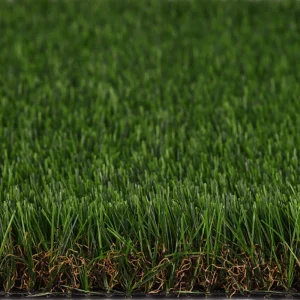
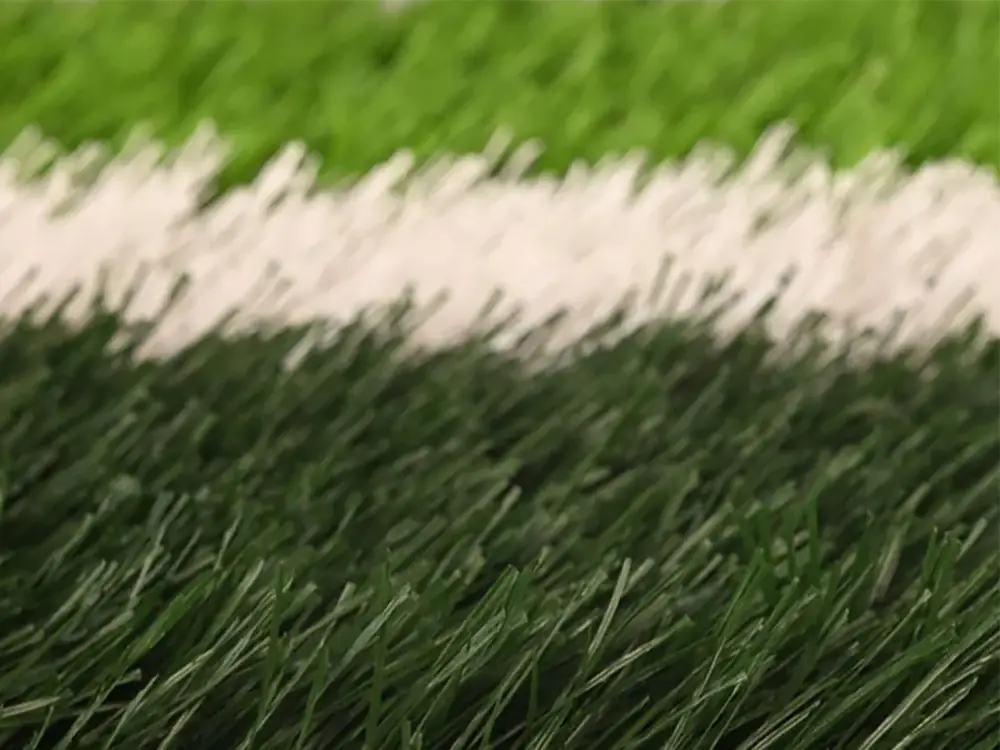
The football turf features PE/9500 polyethylene fibers at a 50mm pile height — a configuration that provides the durability and UV resistance required for outdoor sports environments, combined with the shock absorption and ball roll stability essential for competitive play. With a stitch density of 10,500 stitches per square meter, the turf maintains fiber uprightness under sustained foot traffic, significantly delaying the onset of matting and wear commonly seen in lower-density products.
The backing system incorporates a black-green anti-aging base with tear-resistant reinforced mesh, ensuring secure tuft lock and seam integrity under high-intensity use. The XPU coating offers superior adhesion and flexibility compared to conventional latex or PU alternatives, maintaining bond strength across a wide temperature range. Additional performance features include UV stabilizers to prevent fiber degradation, heat insulation to reduce surface temperature buildup, flame-retardant properties that meet indoor and outdoor safety standards, and automatic water permeation for rapid drainage and minimal downtime after rain.
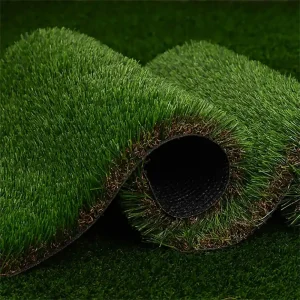
The turf is supplied in 4-meter rolls with customizable lengths, and can be cut freely to accommodate irregular field shapes. At 1.7 kg per square meter, it provides adequate stability for professional use while remaining manageable during installation.
Overall, DJK50 football grass meets the performance requirements of professional football, rugby, hockey, and multi-sport facilities across the key metrics that define quality turf — pile height, fiber composition, stitch density, backing strength, weather resistance, and drainage efficiency.
Technical Specifications at a Glance
| Parameter | Specification |
| Model | DJK50 |
| Fiber Material | PE/9500 |
| Pile Height | 50mm |
| Gauge | 5/8 inch |
| Stitch Density | 10,500 stitches/m² |
| Back Coating | XPU |
| Color | Dark Green + Light Green blend |
| Weight | 1.7 kg/m² |
| Roll Size | 4m (width) × Length customizable |
| Packaging | Roll in PP bag |
| Backing Structure | Black-green anti-aging base + tear-resistant reinforced mesh |
Conclusion
Selecting the right artificial turf for a football field requires comprehensive evaluation of multiple factors: field usage, usage intensity, athletic performance requirements, and long-term maintenance budgets. Among the various indicators, pile height, fiber material, stitch density, backing strength, UV resistance, and drainage capacity form the core framework for judging turf quality.For football fields, 50mm pile height combined with PE fibers and high stitch density in a reinforced turf offers a well-proven balance between athletic performance, player safety, and durability. As a representative product in this specification, DJK50 meets professional sports field requirements across key areas including fiber grade, stitch density, backing structure, anti-aging performance, and drainage efficiency — suitable for football, rugby, hockey, and various other sports applications. If you are interested in our products, please feel free to contact us for more information and a quote.