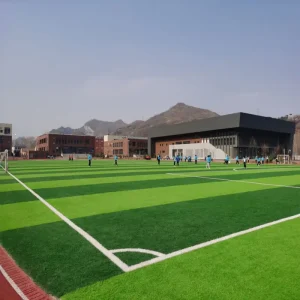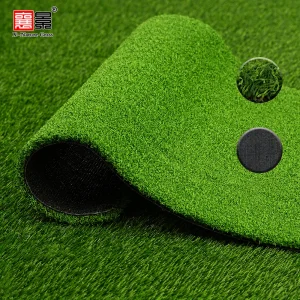
In the past, synthetic turf was often seen simply as a “green plastic mat,” but today, modern athletic facilities treat commercial sports turf as a carefully engineered polymer system.
A commercial athletic pitch used year-round and under heavy traffic needs to meet three key requirements: a player-friendly surface , strong resistance to wear from cleats, and fast drainage after heavy rain.Therefore, selecting the right yarn material and structural design is the first step in developing a high-performance sports turf system.
Why Polyethylene (PE) Dominates Commercial Athletic Fields
Early-generation artificial turf utilized Polypropylene (PP) or Nylon fibers. PP fibers exhibited high surface stiffness, which frequently caused friction burns during slide tackles. Nylon offered high abrasion resistance but lacked elastic memory and dimensional stability under wet conditions.
Modern Polyethylene (PE) formulations resolve these limitations by offering superior fiber flexibility and polymer elastic memory. PE provides a soft touch that minimizes friction abrasion during falls, while retaining the structural memory needed to spring back upright after continuous cleat impacts.
Key Parameters to Consider When Choosing Commercial Artificial Turf
1. Gauge: 5/8 Inch Affects Fiber Spacing and Infill Distribution
Gauge determines the spacing and arrangement of the turf fibers across the backing.
A 5/8-inch gauge provides practical spacing between fiber rows, allowing infill to settle properly while supporting effective water drainage.
When selecting sports turf,gauge should not be considered separately. Gauge, pile height, and stitch density should be evaluated together to determine how effectively the infill distributes through the turf.
2. Stitch Density: 10,500 Stitches/m² Supports Surface Coverage and Stability
High-use sports fields need good surface coverage and stable footing.
With 10,500 stitches/m², the turf has a dense fiber distribution that helps reduce backing exposure and provides players with a more stable surface underfoot.
The right stitch density helps to:
- Maintain a more even playing surface
- Provide consistent traction
- Reduce fiber flattening during long-term use
- Maintain the overall appearance of the turf
For procurement, do not compare products by stitch count alone. Consider Dtex, pile height, gauge, and stitch density as a complete set of specifications.
3. Backing System: An Important Factor in Long-Term Performance
The turf fibers handle much of the friction generated during play, while the backing system supports the overall structure of the turf.
For high-use sports fields, the backing must withstand:
- Repeated foot traffic
- Pulling and stress on the fibers
- Sun and rain
- Temperature changes
- Freeze-thaw cycles
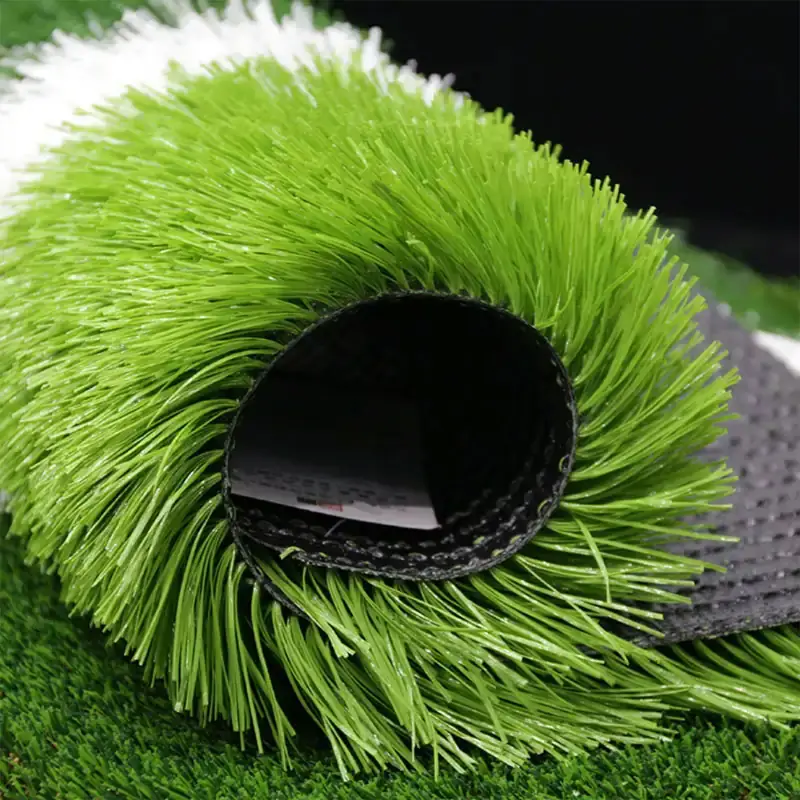
An XPU anti-aging coating combined with a tear-resistant reinforcement mesh improves backing stability and tear resistance, while helping the turf withstand prolonged outdoor exposure.
When selecting professional sports turf, look beyond the yarn specifications. The backing system is also an important factor in determining whether the turf is suitable for long-term, high-intensity use.
4.Roll Specifications: Consider Installation Efficiency
For large sports fields, roll dimensions can directly affect installation efficiency.
The turf is available in a 4.0 m width, with customized roll lengths to suit project requirements. The wider roll format can reduce the number of seams required on site, while custom lengths help minimize on-site cutting and material waste.
How Model DS50 Balances Durability and Player Comfort
For project engineers and procurement officers, technical specifications must translate directly into athlete safety, predictable ball mechanics, and long-term facility ROI. Model DS50 is engineered around these operational priorities.
Model DS50 Technical Parameters & Operational Value
| Technical Parameter | Specification Value (Model DS50) | Operational & Performance Value |
| Yarn Polymer / Dtex | Premium PE / 11,000 Dtex | High tensile strength; resists fiber splitting and fibrillation under heavy cleat shear forces. |
| Pile Height | 50 mm (1.97 in) | Optimal depth ratio for sand/rubber infill balance, mimicking natural turf ball rebound. |
| Gauge Ratio | 5/8 Inch | Balanced row spacing for deep infill penetration and vertical water infiltration. |
| Stitch Density | 10,500 stitches/m² | High fiber coverage maintains surface firmness, foot traction, and fiber upright stability. |
| Backing Coating | XPU Anti-Aging Coating + Anti-Tear Reinforced Mesh | Delivers high tuft pull-out resistance ; resists moisture degradation and thermal aging. |
| Surface Weight | 2.51 kg/m² | Substantial material ballast; prevents surface shifting, seam wrinkling, and carpet migration. |
| Roll Specification | 4.0m Width × Custom Length (PP Bag Wrapped) | Wide-format rolls reduce field seam counts, optimize container freight volume, and cut site labor. |
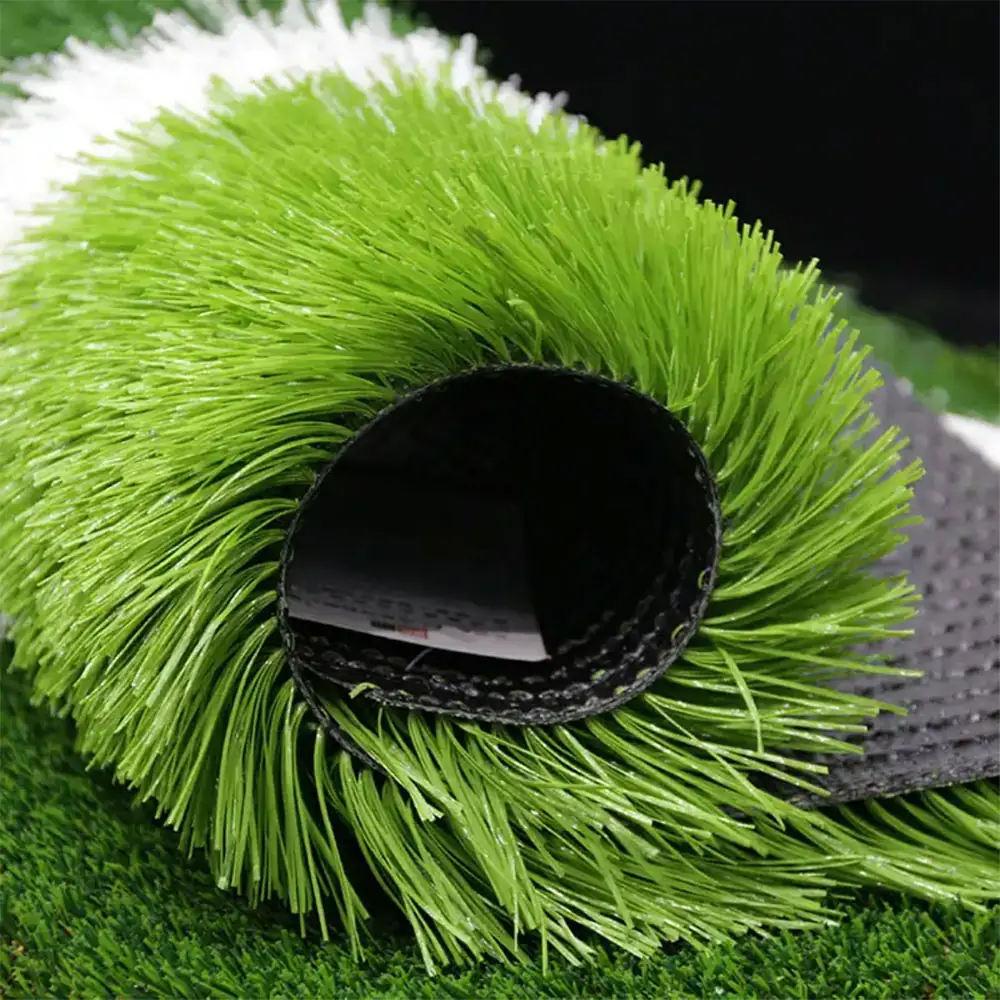
Matching DS50 to Specific Facility Needs
Different sports demand distinct performance parameters for ball roll speed, shock attenuation, and foot traction. With its 50mm pile height and durable construction, Model DS50 serves a wide range of athletic facility applications:
1. Championship Soccer & Football Pitches
A 50mm pile height represents the international standard for full-size football and soccer fields. It supports a 30–35mm infill profile while leaving 15–20mm of exposed fiber tip. This balance ensures natural ball roll and bounce while allowing cleats to penetrate and release smoothly, reducing strain on players’ knees and ankles.
2. Multipurpose Municipal & K-12 School Sports Complexes
School districts and municipal parks require a single field surface capable of supporting back-to-back schedules across soccer, lacrosse, field hockey, and intramural sports. With its high stitch density (10,500 stitches/m²) and 11,000 Dtex fiber, DS50 stands up to continuous multi-sport traffic without requiring extensive maintenance downtime between events.
3. Commercial Training Centers & High-Traffic Arenas
Commercial sports complexes run near full capacity year-round. High-stress areas—such as goal boxes, penalty spots, and mid-field lines—often suffer premature fiber wear. DS50’s wear-resistant PE structure helps delay fiber fatigue in these zones, maintaining uniform field appearance and playability over time.
Why DS50 Fits Long-Term Capital Budgets
When evaluating sports turf, facility owners and general contractors should look beyond the initial material cost. They also need to consider the Total Cost of Ownership (TCO), including installation labor, maintenance, and expected service life.
1. Freight and Field Installation Efficiency
Model DS50 is supplied in standard 4.0-meter widths with factory-customized roll lengths tailored to site CAD drawings. Compared to narrower rolls, 4-meter wide rolls reduce field seams by up to 30%, speeding up installation timelines, lowering labor costs, and eliminating weak seam points. Rolls are packed in UV-stabilized Polypropylene (PP) bags to protect the material during sea and land transit.
2. Rapid Drainage and All-Weather Availability
When installed over a permeable crushed-stone aggregate base, the DS50 system allows surface water to drain quickly through its porous backing. This helps the field dry faster after heavy rain, reducing weather-related cancellations and keeping the field available for more scheduled use.
3. Environmental Compliance & Procurement Safety
Public tenders and school projects often have strict chemical safety requirements. The turf is manufactured with attention to heavy-metal screening and lead-related safety requirements, helping support compliance with applicable local municipal and public procurement standards.
Frequently Asked Procurement Questions
Q1: Why is a 50 mm pile height standard for full-size football and soccer fields?
A 50 mm pile height leaves enough space for a 30–35 mm sand and rubber infill layer, while keeping 15–20 mm of the fiber tips exposed. This setup provides good traction and energy response while allowing the ball to roll and bounce naturally.
Q2: How does XPU backing compare with standard latex backing?
XPU (Polyurethane) forms a strong cross-linked bond around each tuft. Unlike latex, it is less prone to hydrolysis or degradation when exposed to standing water, high temperatures, or freeze-thaw cycles. This helps maintain tuft bind strength and backing integrity over time.
Q3: What does an 11,000 Dtex rating mean for commercial sports turf?
Dtex measures the yarn mass in grams per 10,000 meters. An 11,000 Dtex rating indicates a thick and durable fiber structure. This helps the individual blades resist splitting, fraying, and flattening under heavy and repeated cleat traffic.
Q4: What are the packaging and delivery specifications for Model DS50?
Model DS50 is supplied in 4.0-meter-wide rolls, with the roll length customized to suit project CAD layouts. Each roll is wrapped in a heavy-duty, anti-aging PP woven bag to protect the turf during transpacific container shipping and overland transportation.
Conclusion
Picking turf for a high-use field isn’t about isolated specs—it’s about how the entire system works together. By pairing resilient PE fibers and a 50mm pile with an anti-aging XPU backing, fields like the DS50 strike the perfect balance between long-term durability and player comfort. For procurement teams, opting for wider rolls and a cross-linked backing lowers total cost of ownership, cuts maintenance downtime, and guarantees safe, year-round play.
If you are choosing artificial turf for a high-traffic football facility, feel free to contact Xiangjing. We can recommend suitable turf configurations and technical solutions based on your field type, usage frequency, and project requirements. Our goal is to help you balance performance, maintenance needs, and long-term operating costs. Contact us for detailed DS50 specifications and a project quotation.