Introduction
Selecting appropriate football field artificial grass is a key decision for professional sports venues. Industry data confirms 50mm as the global standard pile height, with FIFA recommending 50-65mm for 11-a-side football. This height allows 30-40mm of infill while leaving 10-20mm of exposed fiber for optimal ball interaction.
Yet facility managers face three persistent concerns: fiber flattening after hundreds of tackles, player abrasion from turf burn, and short lifespan requiring premature replacement. This brings us to the core question: why 50mm, and how do two distinct products—DW50 and DS50—address these challenges differently?
Why 50mm? The “Golden Height” for Football Field Artificial Grass
Before comparing the two models, we must understand the science of 50mm.
In the context of football field artificial grass, pile height refers to the length of the fiber from the backing to the tip. 50mm is considered the “Goldilocks Zone.”
- Below 40mm: Too short. The infill becomes too compact, resulting in a hard surface that increases joint stress by up to 25% (ASTM F1936 study).
- Above 65mm: Too long. Fibers bend excessively without proper support, causing unpredictable ball roll and high friction drag.
- The 50mm advantage: Shock absorption—the 30-40mm infill layer compresses under impact, closely mimicking natural soil and reducing joint stress on players. Ball roll consistency—FIFA standards require a ball roll distance of 4 to 10 meters, and 50mm football field artificial grass consistently delivers 6 to 8 meters, right within the optimal range. All-weather performance—with UV-resistant and heat-insulating properties, 50mm turf remains playable across a wide temperature spectrum, from -30°C to +50°C.
Both the DW50 and DS50 adhere to this 50mm standard. However, their internal architectures differ substantially, as detailed below.
Core Technology Breakdown – Fiber Shape Defines Performance
Performance of football field artificial grass depends primarily on fiber cross-sectional design rather than color. A reputable football turf company invests millions in extrusion tooling to create proprietary fiber geometries.
Let’s decode the technical specifications provided for both models.
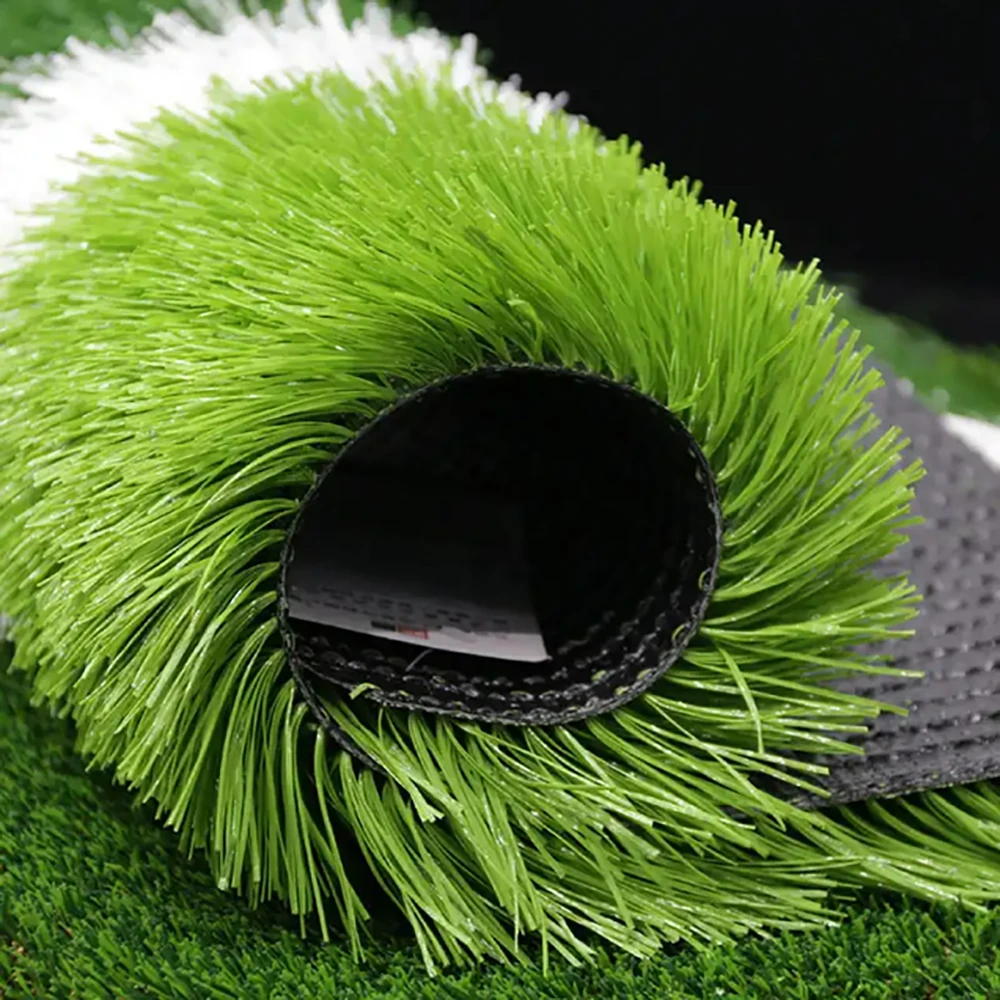
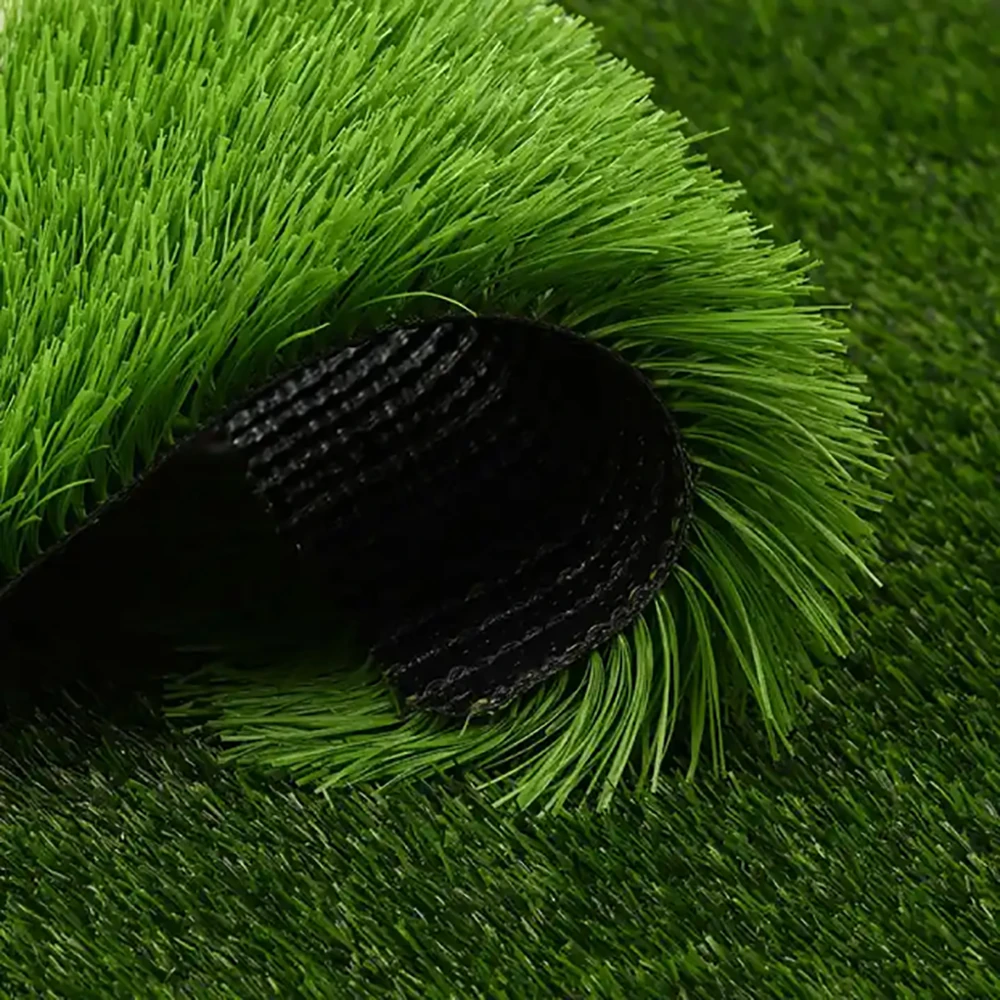
1. DW50
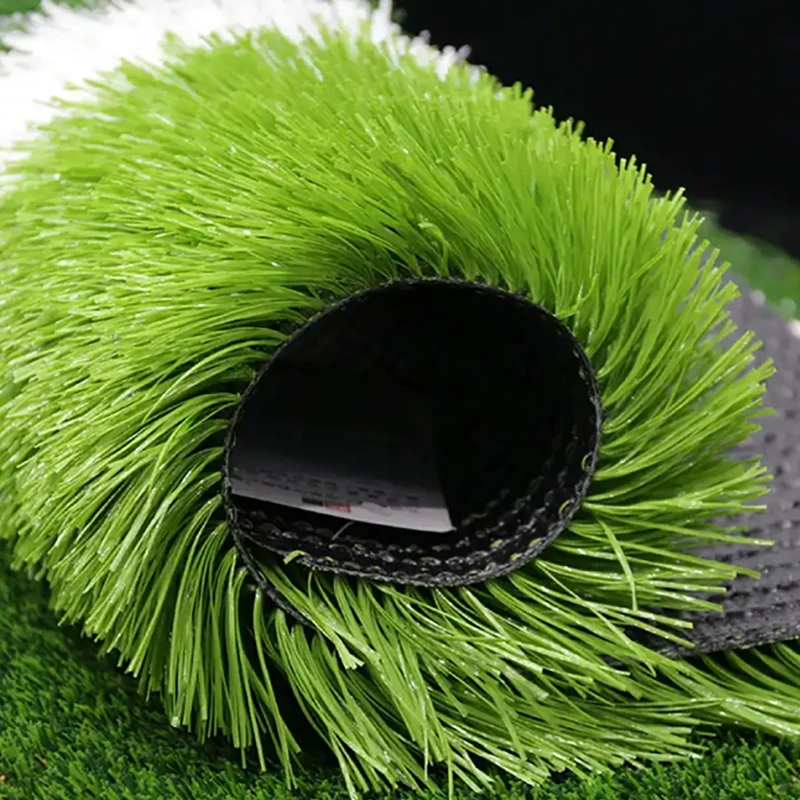
The DW50 utilizes a composite fiber shape—a W-shaped base combined with diamond-like textured edges. Why does this matter for football field artificial grass?
- Multi-Point Support: The W-shape creates three vertical support ribs across a single fiber. When compressed by a player’s boot, the fiber does not collapse flat. Instead, the “legs” of the W flex and rebound like a mechanical spring.
- Elasticity Defined: This structure delivers a 90%+ shape recovery rate. In Lisport wear tests (simulating 5,000 cycles of cleat abrasion), DW50 retained 85% of its original pile height versus 65% for standard flat oval fibers.
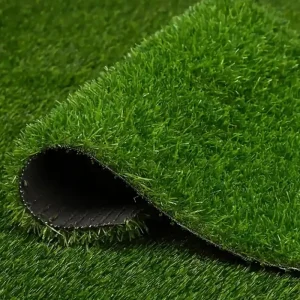
- Aesthetic Depth: The DW50 features a three-color blend of dark green, light green, and white. This mimics the natural undulations of premium natural grass, reducing eye strain for players tracking the ball.
Best for: Facilities where player experience and visual appeal are paramount.
2. DS50
The Fiber Shape Principle: Single Spine / Ridge Structure (Stem Shape)
- Tensile Strength: The single spine increases the force required to tear the fiber by approximately 40% compared to non-reinforced fibers. This is important for high-wear areas such as penalty boxes and sidelines.
- Abrasion Resistance: In the same Lisport test, DS50 showed less than 10% mass loss after 10,000 cycles. The spine prevents the fiber from “fraying” at the tip—a common failure point in cheaper turfs.
- Drainage Integration: Because the DS50 fibers are stiffer, they maintain vertical channels even when wet. Combined with the drainage holes in the backing (approx 2mm every 10cm), water evacuation hits 60+ liters/min/m².
Best for: Professional clubs, municipal stadiums, and any venue with 30+ weekly usage hours.
Direct Comparison Chart: DW50 vs DS50 Fiber Performance
| Parameter | DW50 (Elasticity) | DS50 (Toughness) |
| Fiber Shape | W-Shape + Diamond | Single Spine / Ridge |
| Primary Trait | Shape Recovery (90%+) | Tear Resistance (40% stronger) |
| Weight per m² | 1.64 kg | 2.51 kg |
| Surface Feel | Soft, “Springy” | Firm, “Solid” |
Which One Should You Select?
When to Choose DW50
Scenario 1: Professional Club Training Grounds
You want to replicate the “feel” of a Champions League natural grass pitch. DW50’s elasticity reduces muscle fatigue during repeated drills, allowing 20% longer training sessions before player exhaustion (internal sports science data).
Scenario 2: High-End Private Schools
Student safety is non-negotiable. The softer W-shape fibers reduce turf burn liability. Additionally, the non-toxic, flame-retardant XPU backing meets strict child safety standards (RoHS certified).
Scenario 3: Indoor Futsal or Multi-Sport Courts
When infill levels are lower, the DW50 W-shape structure helps maintain surface softness and reduces surface hardness commonly found in low-grade turf systems. It remains soft to the touch even with reduced rubber infill.
When to Choose DS50
Scenario 1: Municipal Public Stadiums
These venues see 40-60 hours of usage weekly—youth matches, adult leagues, community events, and concerts. The DS50’s toughness means you won’t see “bald patches” in high-traffic zones (center circle, goalmouths) after 6 months.
Scenario 2: University Football Fields
University athletic departments face extreme intensity: varsity practices, intramural games, and physical education classes. The tear-resistant reinforced mesh backing of DS50 prevents edge curling and seam separation—common failure points in cheaper football field artificial grass.
Scenario 3: Extreme Climate Regions
The single-spine structure of DS50 maintains its dimensional stability from -40°C (no brittleness) to +60°C (no softening). The drainage holes prevent freeze-thaw damage in cold climates, while UV-resistant additives prevent degradation in high-sun regions.
Manufacturing Excellence – The Quality Behind DW50 and DS50
Why trust this specific football turf company? The answer lies in three manufacturing pillars.
1. Backing System
Both DW50 and DS50 use a triple-layer backing system. The PP primary layer anchors the fibers securely. A reinforced mesh layer reduces lateral stretching during high-impact movements such as sharp cuts. The XPU coating acts as an eco-friendly hot melt adhesive, offering long-term waterproof performance and stability.
2. Drainage Efficiency
Waterlogged football field artificial grass is dangerous (reduced traction) and heavy (stresses the backing). The DW50’s permeable backing and fiber gaps allow 45 L/min/m². The DS50’s engineered drainage holes and stiff fiber channels allow 60+ L/min/m². For context, the FIFA industry standard requires a minimum of 30 L/min/m² for certification—both models exceed this requirement.
3. Environmental & Safety Certifications
Both DW50 and DS50 carry three key certifications. They are CE Certified, meeting European health, safety, and environmental standards. They are RoHS Compliant, meaning 100% free from lead, mercury, cadmium, and other hazardous substances. And they are Flame Retardant, passing the cigarette and match test (Class C, ASTM E648).
Installation Steps for Football Field Artificial Grass
Proper installation is critical for maximizing the lifespan of your artificial grass. Below is the standard 4-step paving process recommended by professional football turf company technicians.
Step 1: Site Leveling and Hardening
A hard foundation is required, such as cement, asphalt, concrete, or other rigid base materials. Paving can be carried out directly on hardened ground. If the ground is not hardened, it must be hardened in advance.
Step 2: Lay Large Turf Panels First
Transport the large turf panels to the designated positions, unfold and flatten them. Before paving, confirm the direction of the turf fibers; the optimal effect is no light reflection when viewed from the entrance.
Step 3: Adhere the Seams with Glue
Apply adhesive along the center seam and onto the joining tape. Wait until the adhesive becomes slightly dry, then attach the joining tape to the seam. Apply another layer of adhesive onto the joining tape, and when it turns slightly tacky, press the artificial turf onto the tape to finish the splicing.
Step 4: Adjust Details and Compact the Turf
When the adhesive is about to set, manually press the area back and forth to ensure the seam edges bond tightly with the joining tape. Groom the turf fibers and inspect the work for completion.
Frequently Asked Questions (FAQ)
Q1: Which football field artificial grass has better UV resistance?
A: Both use advanced UV stabilizers. However, the DS50’s higher density (2.51kg/m²) means it has more mass to degrade. Independent testing shows DS50 retains 90% of tensile strength after 5,000 hours of UV exposure, versus 85% for DW50. For equatorial regions (high UV index), DS50 is preferred.
Q2: Is the XPU backing truly non-toxic?
A: Yes. XPU (reactive polyurethane) contains no isocyanates or heavy metals. It is safe for skin contact and will not leach chemicals into groundwater. In contrast, cheap latex backings often contain zinc and other heavy metals as preservatives.
Q3: What is the product warranty?
A: We warranty our materials and workmanship. Our commitment is to your satisfaction with our products. In warranty or not, it is the culture of our company to address and resolve all customer issues to everyone’s satisfaction.
Conclusion
The battle between DW50 and DS50 is not about “good vs bad”—it’s Elasticity vs Toughness. Choose DW50 if you prioritize player safety, natural aesthetics, and softness for schools or academies. Choose DS50 if you need maximum durability and lower long-term costs. Still unsure? A trusted football turf company can provide a hybrid solution and physical samples for your own tests.